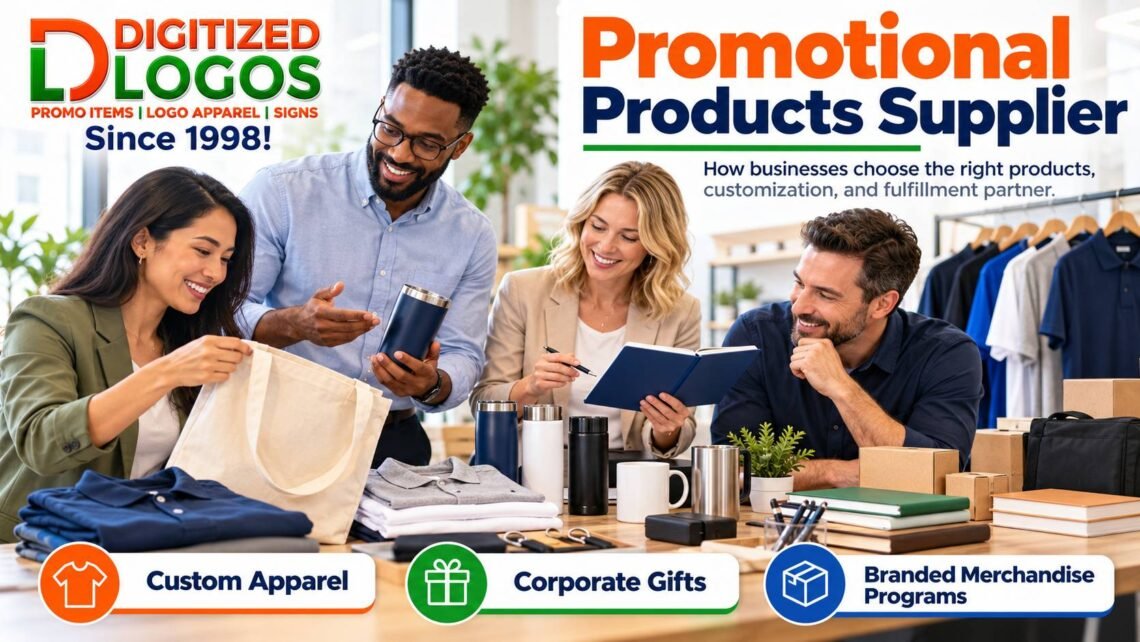
Finding the right promotional products supplier involves more than selecting merchandise and adding a company logo. Business buyers need products that suit their audience, represent their brand accurately, fit their budget, and arrive when they are needed.
Digitized Logos is a promotional products supplier providing customized merchandise, branded apparel, corporate gifts, and business promotional solutions. From trade show giveaways to employee uniforms and company merchandise programs, Digitized Logos helps organizations select, customize, and distribute products for their business needs.
For purchasing managers, marketing departments, HR teams, and business owners, working with a dependable supplier can simplify product selection, artwork approvals, purchasing, and delivery coordination.
What Does a Promotional Products Supplier Do?
A promotional products supplier sources and customizes merchandise that organizations use for marketing, employee recognition, corporate gifting, events, and everyday business operations. These products typically feature a company logo, brand message, or approved artwork.
A supplier’s responsibilities may extend beyond manufacturing or decorating individual items. Depending on the program, services can include product recommendations, artwork preparation, decoration coordination, production approvals, bulk ordering, and fulfillment.
For example, a company preparing for an industry conference may need branded tote bags, notebooks, and staff polos. Rather than managing several unrelated orders, the purchasing team can coordinate merchandise specifications, branding requirements, and delivery arrangements through one supplier.
Why Businesses Work With a Custom Promotional Products Supplier
A custom promotional products supplier helps organizations turn their branding requirements into practical merchandise that employees, customers, and business partners can use.
Custom promotional products serve different purposes depending on the intended recipient and distribution environment. The right product for a customer appreciation program may be unsuitable for a crowded trade show or an employee uniform program.
Businesses commonly work with promotional merchandise suppliers to support:
- Brand awareness: Distributing useful products that display an organization’s name or logo.
- Employee onboarding: Providing branded welcome packages, apparel, and workplace essentials.
- Trade shows and conferences: Preparing promotional giveaways and event merchandise.
- Corporate gifting: Selecting customized gifts for employees, customers, and business relationships.
- Team identification: Creating consistent branded uniforms and apparel.
- Multi-location operations: Coordinating approved merchandise across departments, offices, and regional teams.
Effective promotional merchandise programs begin with a defined business objective. Product usefulness, audience preferences, branding quality, and distribution planning should influence purchasing decisions before an order is placed.
Custom Promotional Products Available for Businesses
Digitized Logos offers businesses access to a broad promotional merchandise catalog covering everyday giveaways, branded apparel, office accessories, and corporate gifting products.
The most appropriate category depends on how recipients will use the merchandise, how prominently the company logo should appear, and the available customization options.
1. Custom Branded Apparel and Corporate Uniforms
Branded apparel helps organizations maintain a recognizable appearance at work, during customer visits, and at business events.
Common options include:
- Custom logo polo shirts
- Branded T-shirts and performance shirts
- Corporate jackets and fleece outerwear
- Embroidered hats and caps
- Hoodies and quarter-zip pullovers
- Employee uniforms and team apparel
Apparel selection should account for fabric performance, comfort, available sizing, laundering requirements, and the intended work environment.
For example, a construction business purchasing employee apparel may prioritize durability and mobility, while a hospitality organization may focus on coordinated colors, fit, and a professional customer-facing appearance.
2. Custom Drinkware
Branded drinkware is a practical merchandise category for office environments, employee programs, conferences, and customer gifts.
Options can include reusable water bottles, tumblers, travel mugs, and ceramic mugs.
When selecting drinkware, buyers should compare capacity, insulation, lid design, cleaning requirements, and available decoration areas. The product should suit the recipient’s daily routine rather than being chosen solely for its appearance.
3. Promotional Bags and Travel Accessories
Custom bags can provide useful carrying space while displaying company branding during business travel, conferences, and daily activities.
Popular categories include tote bags, backpacks, drawstring bags, laptop bags, and travel organizers.
For conference merchandise, consider whether the bag can comfortably hold the materials attendees are likely to receive. For employee onboarding, laptop protection, organization, and durability may be more important.
4. Office Supplies and Writing Instruments
Office promotional products are often appropriate for workplace programs, professional conferences, and customer meetings.
Examples include branded pens, notebooks, journals, desk accessories, and stationery products.
Writing quality, paper construction, imprint readability, and ease of daily use are important selection considerations. A functional office item may be more useful to recipients than an elaborate promotional gift that does not fit their needs.
5. Technology Accessories and Corporate Gifts
Technology accessories and customized gift collections can support employee appreciation, business relationship management, and corporate recognition programs.
Potential options include chargers, portable power banks, technology organizers, headphones, and curated merchandise packages.
Buyers should review compatibility, electrical specifications, applicable safety requirements, packaging, and warranty terms before placing orders for electronic promotional products.
How to Choose the Right Promotional Products Supplier
Choosing a promotional products supplier should involve evaluating product suitability, customization capabilities, ordering requirements, and operational support rather than comparing unit prices alone.
The following purchasing framework can help organizations evaluate suppliers and reduce avoidable ordering problems.
- Define the business objective. Identify whether the merchandise is intended for marketing, staff uniforms, customer appreciation, onboarding, or another purpose.
- Identify the recipients. Consider how the intended audience will use the products and which features provide practical value.
- Establish the complete budget. Include merchandise, decoration, setup charges, packaging, freight, and any applicable fulfillment costs.
- Review customization options. Confirm the available decoration methods, logo placement, imprint dimensions, and artwork requirements.
- Verify order quantities. Ask about minimum quantities, volume pricing, and whether different sizes or colors can be combined.
- Confirm production and delivery requirements. Determine when the order must arrive and allow sufficient time for approvals, production, and transportation.
- Evaluate ongoing support. For repeat purchases, ask about approved artwork records, product consistency, company stores, and fulfillment services.
A supplier that communicates requirements clearly can help buyers identify potential problems before production begins. This is particularly valuable when merchandise involves multiple products, departments, delivery addresses, or approval stakeholders.
Understanding Promotional Product Customization Methods
Different promotional products require different branding techniques. The most appropriate method depends on the product material, logo details, decoration area, desired appearance, and order requirements.
Embroidery
Embroidery uses stitching to reproduce artwork on suitable textile products. It is commonly selected for polos, jackets, caps, and corporate uniforms.
Buyers should consider stitch density, fabric stability, fine details, and logo dimensions. Very small lettering or complicated artwork may require adjustments to remain legible when stitched.
Screen Printing
Screen printing transfers ink through prepared screens onto suitable surfaces, commonly apparel.
It can be appropriate for larger quantities of T-shirts and event merchandise featuring consistent artwork. The number of colors, print locations, garment material, and production setup can affect pricing and suitability.
Heat Transfer
Heat transfer methods apply designs using heat and pressure. Depending on the specific process, they can accommodate multicolor artwork and detailed graphics on compatible materials.
Fabric composition, surface characteristics, wash durability, and application conditions should be evaluated before selecting a transfer method.
Dye Sublimation
Dye sublimation uses heat to transfer specialized dyes into compatible materials, commonly polyester fabrics and polymer-coated surfaces.
This method can be especially useful for full-color graphics and custom apparel designs. For fabric applications, the polyester content and base color affect the achievable result, so buyers should confirm material suitability before approving artwork.
Digitized Logos offers dye sublimation capabilities alongside other merchandise customization options, allowing buyers to explore decoration approaches appropriate to their product requirements.
Behind the Scenes: Why Artwork Approval Matters
One of the most important stages in promotional merchandise production occurs before the first item is decorated.
A logo that looks sharp on a computer monitor does not automatically reproduce well on a small pen, embroidered cap, or textured promotional bag.
For instance, a detailed logo containing narrow lettering may look clear on a large T-shirt graphic but become difficult to read when reduced to a small embroidery area.
Professional artwork preparation may involve checking:
- Vector file availability and image resolution
- Correct brand colors and approved logo variations
- Minimum readable text and line thickness
- Product-specific decoration dimensions
- Artwork orientation and placement
- Compatibility between the chosen material and decoration process
Color reproduction also requires attention. A screen color, embroidery thread, and printed ink may not appear identical because their materials and production processes differ.
Buyers should review digital proofs carefully and request physical samples when color accuracy, fit, finish, or material performance is particularly important. A digital proof generally confirms artwork layout and positioning, but may not fully represent the finished item’s texture or color appearance.
How Much Do Custom Promotional Products Cost?
The cost of custom promotional products depends on product selection, order quantity, decoration technique, branding complexity, and fulfillment requirements. There is no single unit price that accurately represents every customized merchandise order.
Common pricing variables include:
- Base product and material quality
- Order quantity and available volume discounts
- Number of logo colors and decoration locations
- Artwork setup and production requirements
- Personalization, such as individual employee names
- Packaging and kitting services
- Shipping destinations and delivery requirements
Example: Suppose a business is comparing two hypothetical promotional merchandise options for 200 recipients. Option A costs an assumed $4 per item, while Option B costs $7 per item.
The merchandise-only totals would be $800 and $1,400, respectively, before decoration, setup, taxes, freight, or additional services.
The lower-priced choice is not necessarily the better purchase. If the more expensive product is substantially more useful or appropriate for the recipients, the additional cost may be justified by the program’s objectives.
Businesses should request an itemized quote and compare the full delivered cost rather than relying exclusively on advertised unit pricing.
Promotional Merchandise for Different Industries
Different industries have different operational requirements, branding environments, and purchasing considerations.
Corporate Offices and Professional Services
Corporate organizations commonly purchase branded apparel, employee welcome kits, office accessories, and recognition gifts.
For recurring programs, consistent logo placement, approved products, and predictable reordering processes can reduce administrative work.
Hospitality and Restaurants
Hospitality businesses may use branded polos, uniforms, hats, drinkware, and staff recognition products to support daily operations and employee programs.
Comfort, wash care, fabric durability, and consistent brand presentation are particularly relevant when employees wear customized garments regularly.
Healthcare Organizations
Healthcare buyers may require branded outerwear, administrative team apparel, employee appreciation merchandise, and event giveaways.
Product suitability should be assessed against workplace policies, laundering needs, and any applicable hygiene or safety requirements.
Construction and Real Estate Businesses
Construction firms and real estate organizations may use branded apparel, promotional bags, notebooks, and client gifts for employee identification, business development, and customer engagement.
When purchasing products for field personnel, practical durability and working conditions matter. Promotional apparel should not be assumed to satisfy personal protective equipment or safety standards unless the specific products have been verified for those requirements.
Realistic Business Examples: Promotional Products in Practice
Example 1: Trade Show Merchandise for a Growing Business
Consider a hypothetical software company preparing to exhibit at an industry conference. The marketing team wants useful giveaways that fit a defined budget and are easy for visitors to carry.
Instead of ordering several unrelated items, the team selects one practical giveaway, branded staff apparel, and a smaller quantity of premium merchandise for scheduled meetings.
The purchasing process includes reviewing artwork, confirming quantity requirements, coordinating shipping to the event destination, and establishing an arrival date that allows time to resolve delivery issues.
This approach connects merchandise selection with the company’s actual event activities instead of purchasing products based only on popularity.
Example 2: Employee Apparel for a Multi-Location Organization
Imagine a hypothetical hospitality business with several properties that needs consistent branded apparel for employees.
Without a standardized purchasing process, individual locations might choose different garment styles, logo dimensions, or decoration colors.
A coordinated apparel program could establish approved styles, consistent artwork, standardized decoration locations, and an organized ordering process.
For repeat ordering, the organization could also consider a company store that allows authorized purchasers to select merchandise from an approved collection.
These examples are illustrative purchasing scenarios, not claims about specific Digitized Logos customer projects or results.
Bulk Promotional Products vs. Flexible Ordering Programs
Bulk ordering and smaller recurring orders solve different business problems. Neither approach is automatically better for every organization.
Bulk purchasing can be suitable for conferences, company-wide campaigns, planned employee distributions, and merchandise with predictable demand. Larger quantities may reduce unit costs, but they can also increase storage requirements and the risk of unused inventory.
Flexible or smaller-volume ordering can be useful when teams have changing staffing needs, individualized apparel sizes, or recurring merchandise requests.
Digitized Logos offers selected no-minimum customization programs, while other products may have supplier-specific minimum quantities. Buyers should verify eligibility, pricing, and customization conditions for the items they want.
Organizations expecting frequent reorders should consider both unit economics and administrative efficiency. A slightly higher per-unit cost may be reasonable if an ordering model avoids unnecessary inventory, storage, or manual coordination.
Company Stores and Fulfillment for Ongoing Merchandise Programs
A company store is an online purchasing environment where employees, departments, or approved buyers can order merchandise from a curated selection.
Unlike a one-time promotional order, a company store can provide a recurring process for managing approved apparel and promotional products.
Digitized Logos supports company stores, branded merchandise programs, kitting, and fulfillment services for business customers.
Depending on the program design, organizations can coordinate:
- Preapproved logo apparel and merchandise selections
- Employee and department ordering requirements
- Artwork and branding consistency
- Bulk purchases and replenishment planning
- Customized onboarding and corporate gift kits
- Shipping to individual recipients or multiple business locations
Before implementing a company store, buyers should clarify who can order, who pays, which merchandise is approved, how inventory will be managed, and what happens when a product becomes unavailable.
These decisions help prevent an online merchandise program from creating additional administrative problems.
Common Mistakes When Ordering Promotional Products
Ordering problems frequently originate from incomplete specifications, unclear expectations, or decisions made too close to a required delivery date.
Businesses can reduce purchasing risk by avoiding these common mistakes:
- Choosing products based only on price: Consider functionality, material quality, recipient preferences, and total cost.
- Sending unsuitable artwork: Confirm file formats, design dimensions, and reproduction requirements before production.
- Overlooking product minimums: Check quantity restrictions before finalizing the merchandise selection.
- Ignoring sizing requirements: Review size charts and garment specifications for branded employee apparel.
- Assuming every product has the same turnaround: Production requirements vary by item, decoration method, quantity, and availability.
- Ordering without a distribution plan: Determine where products will be stored, shipped, or handed out.
- Skipping proof review: Verify spelling, logo placement, artwork dimensions, and decoration details before authorization.
For event orders, it is especially useful to establish the required in-hand date rather than communicating only the date of the event. The buyer may need additional time to organize merchandise, prepare kits, or transport items to the venue.
Why Consider Digitized Logos for Business Promotional Products?
Digitized Logos provides promotional products, branded apparel, and corporate merchandise services for organizations seeking customized products and support with business purchasing requirements.
Its services include merchandise sourcing, logo customization, company stores, corporate gifting, and fulfillment coordination.
Based in Gaithersburg, Maryland, Digitized Logos works with business customers across the United States, including organizations in Maryland, Washington DC, and Virginia.
Businesses evaluating Digitized Logos can explore merchandise categories, request guidance on suitable products, and discuss customization and ordering requirements before purchasing.
For organizations planning recurring branded merchandise programs, the discussion can also include approved product selections, replenishment needs, individual shipping, and company store requirements.
Frequently Asked Questions About Promotional Products Suppliers
What is the difference between a promotional products supplier and a manufacturer?
A manufacturer produces merchandise, while a promotional products supplier helps businesses source, customize, and order merchandise from available product lines. Depending on its service model, the supplier may coordinate artwork, decoration, approvals, and fulfillment across different manufacturing partners, giving business buyers a more centralized purchasing process.
Can I order promotional products with my company logo?
Yes. Many promotional products can be customized with a company logo, text, or approved brand artwork. Available decoration methods vary by product material and imprint area. Buyers should provide clear artwork and confirm the proposed design through the supplier’s approval process before authorizing production.
Do promotional product suppliers require minimum order quantities?
Minimum order quantities depend on the product, manufacturer, and decoration method. Some merchandise requires bulk quantities, while selected items may be available in small quantities or through no-minimum programs. Digitized Logos offers eligible no-minimum options, but buyers should confirm the requirements for each specific product.
How long does it take to receive customized promotional products?
Production and delivery schedules vary according to inventory availability, artwork approvals, decoration methods, quantities, and shipping destinations. Rush options may be available for eligible products. Buyers should communicate their required delivery date and request confirmation of the production schedule before placing an order.
Can one supplier manage promotional products for multiple business locations?
Yes, some suppliers provide centralized ordering, company stores, and multi-location fulfillment services. Digitized Logos offers these types of business merchandise solutions. Organizations should establish approved product standards, ordering permissions, shipping requirements, and inventory responsibilities to maintain consistency across participating locations.
Key Takeaways for Business Buyers
- A promotional products supplier should help align merchandise selection with actual business objectives and recipient needs.
- Product quality, customization methods, minimum quantities, and complete delivered costs deserve attention before purchasing.
- Accurate artwork preparation and proof approvals can reduce avoidable production mistakes.
- Bulk ordering works well for predictable demand, while flexible ordering programs may better support changing requirements.
- Company stores and coordinated fulfillment can support consistent branding and ongoing merchandise distribution across business locations.
Find the Right Promotional Products Supplier for Your Business
Choosing a promotional products supplier is an opportunity to build a more organized, practical, and consistent approach to branded merchandise purchasing.
From custom apparel and event giveaways to employee gifts and ongoing company merchandise programs, the most effective purchasing decisions begin with clear requirements, suitable products, and realistic production planning.
Digitized Logos can help businesses explore branded merchandise options, evaluate customization requirements, and coordinate promotional product orders based on their specific needs.
Explore Promotional Products: Browse the Digitized Logos catalog to discover customizable apparel, corporate gifts, office merchandise, drinkware, bags, and other branded products.
Call: 301-963-3553
Email: info@DigitizedLogos.com