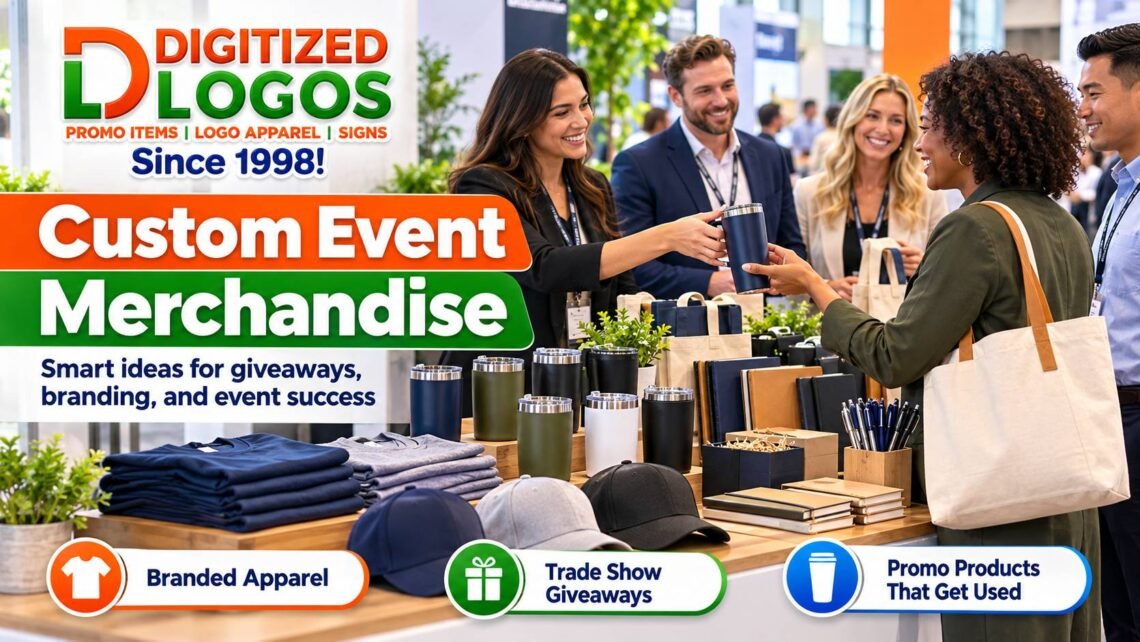
A successful event creates opportunities for conversations, new relationships, and lasting brand recognition. But once attendees leave, what will help them remember your business? Thoughtfully selected custom event merchandise can keep your brand visible long after the event ends.
From corporate conferences and trade shows to employee celebrations and product launches, custom event merchandise gives organizations a practical way to connect with their audiences. The most effective products combine usefulness, attractive design, appropriate branding, and a clear purpose.
At Digitized Logos, businesses can explore customizable promotional products and branded apparel for different event needs. This guide explains how to choose the right merchandise, understand decoration options, plan an event budget, and avoid common ordering mistakes.
What Is Custom Event Merchandise?
Custom event merchandise refers to apparel, accessories, drinkware, bags, and other promotional items personalized with a business logo, event identity, message, or design. Organizations distribute or sell these products at conferences, trade shows, company events, festivals, and other gatherings.
Unlike generic giveaways, event merchandise can be tailored to a particular audience or occasion. A conference tote bag might feature an event name and sponsor logos, while an embroidered polo could identify event staff and reinforce a professional appearance.
The objective is not simply to distribute products. It is to provide something recipients will find useful, attractive, or meaningful enough to keep using.
Why Custom Event Merchandise Matters for Businesses
Well-chosen merchandise can support several business goals simultaneously. It can strengthen event identity, encourage attendee engagement, recognize employees, and provide a tangible reminder of a brand.
Extend Brand Visibility Beyond the Event
A reusable water bottle, quality tote bag, or comfortable T-shirt may remain useful after an event. Each subsequent use creates another opportunity for the recipient to encounter the brand.
However, future use depends on product quality, appearance, and relevance. A promotional item that feels disposable is less likely to deliver ongoing value.
Support Meaningful Attendee Engagement
Merchandise can become part of a larger interaction. At a trade show, a useful branded gift may help start a conversation about the visitor’s needs. At a company gathering, personalized apparel can contribute to a shared experience.
The merchandise should complement the event’s purpose rather than replace genuine engagement.
Create a Consistent Event Experience
Coordinated apparel, table coverings, banners, and attendee gifts can establish a recognizable visual identity. Consistent colors, logos, and messaging make it easier for visitors to identify staff, exhibitors, and designated event areas.
Best Custom Event Merchandise Ideas for Different Events
The right merchandise depends on who will receive it, how it will be distributed, and what the organization wants to accomplish. A product suited to a public festival may not be the right choice for an executive conference.
1. Custom T-Shirts and Branded Apparel
Custom T-shirts are a versatile choice for conferences, charity events, festivals, team activities, and product launches. They provide a relatively large design area and can showcase event graphics, slogans, sponsor information, and company branding.
Other apparel options include polos, performance shirts, jackets, hoodies, and quarter-zips. For professional events, subtle logo placement and neutral colors may be more appropriate than oversized promotional graphics.
Before ordering, review size availability, fabric composition, decoration compatibility, and expected wear conditions.
2. Branded Tote Bags and Backpacks
Tote bags are particularly useful at trade shows and conferences because attendees often need somewhere to store brochures, samples, and other materials.
Canvas, cotton, polyester, and nonwoven bags offer different combinations of structure, durability, weight, and cost. Backpacks and laptop bags may suit higher-value gifts or events involving frequent travel.
Consider bag dimensions, handle strength, print area, and intended carrying capacity before choosing a style.
3. Custom Drinkware
Reusable water bottles, insulated tumblers, travel mugs, and coffee cups can be practical merchandise for conferences, employee events, outdoor gatherings, and hospitality programs.
Product selection should account for insulation, lid design, capacity, material, and cleaning requirements. The available decoration area also matters, particularly when an event logo contains small text or detailed graphics.
4. Promotional Pens and Notebooks
Pens and notebooks remain relevant when attendees are expected to take notes, attend presentations, or participate in workshops.
For a professional conference, coordinated notebooks and pens can create a cohesive welcome package. Higher-quality journals may also work as speaker appreciation gifts or executive meeting materials.
5. Custom Hats and Caps
Branded caps are suitable for outdoor events, employee appreciation programs, community festivals, and team gatherings.
Embroidery can provide a textured appearance, while alternative decoration methods may be better for certain graphics. Cap structure, fabric, closure style, and decoration location should be considered together.
6. Tech Accessories
Charging cables, device stands, cable organizers, and other technology accessories may be useful to business travelers and conference participants.
Before purchasing electronic products, confirm device compatibility, relevant safety documentation, warranty terms, and any transportation restrictions.
7. Premium Corporate Gifts
Some events call for a smaller quantity of carefully chosen products rather than broad giveaway distribution.
Premium jackets, travel accessories, gift sets, and selected desk products may be appropriate for speakers, executives, event partners, or employee recognition programs.
In these situations, perceived quality and recipient relevance are generally more important than distributing the largest possible number of items.
How to Choose Event Merchandise With Logo Branding
Choosing event merchandise with logo requires more than selecting a product and uploading artwork. The merchandise must work for its audience, environment, and intended use.
Start by answering four questions:
- Who will receive it? Customers, prospects, employees, sponsors, or invited guests?
- Where will it be used? At an indoor conference, outdoor festival, exhibition booth, or company celebration?
- What is the business objective? Brand awareness, appreciation, team identification, or lead engagement?
- What is the available budget? Consider the complete delivered cost rather than the advertised product price alone.
For example, a lightweight tote bag may be useful at a multi-day exhibition, while a decorated performance polo could be more suitable for an outdoor company event.
Logo visibility should also be balanced with aesthetics. A discreet, well-positioned logo can be more appealing on premium apparel than a large graphic that overwhelms the garment.
Understanding Event Merchandise Customization Methods
The decoration process can affect appearance, durability, cost, and artwork preparation. Understanding the differences helps buyers choose suitable products and avoid unexpected results.
Screen Printing
Screen printing is frequently used for T-shirts, tote bags, and similar products. It is well suited to certain bold graphics and repeat designs, although production economics depend on color count, setup requirements, and quantity.
Not every design or material is appropriate for traditional screen printing.
Embroidery
Embroidery uses stitching to reproduce a design on fabric. It is commonly used for polos, caps, jackets, and uniforms.
Very small lettering, fine gradients, and complex details may require artwork adjustments. Stitch density and fabric characteristics can also affect the finished appearance.
Dye Sublimation
Dye sublimation is particularly useful for full-color graphics on suitable polyester-based fabrics and compatible coated products.
Using heat, sublimation dyes are transferred into compatible materials. On suitable polyester textiles, the resulting decoration becomes part of the fabric rather than forming a conventional raised ink layer.
This technique can be valuable for event jerseys, performance apparel, printed fabric displays, and certain promotional accessories.
However, dye sublimation is not universally suitable for every material or color. Traditional sublimation generally performs best on white or light-colored polyester surfaces, and artwork preparation must account for product construction, color variation, and production tolerances.
Digital Printing and Heat Transfers
Digital printing and transfer-based decoration can accommodate certain detailed designs and smaller production requirements, depending on the product and process.
Material compatibility, wash care, print feel, durability expectations, and available decoration areas should be reviewed before approving production.
How to Plan a Custom Event Merchandise Order
A structured purchasing process helps businesses manage costs, coordinate approvals, and reduce avoidable event preparation problems.
- Define the event objective. Determine whether the merchandise is intended for attendee distribution, staff identification, recognition, or resale.
- Estimate the required quantity. Consider registrations, expected attendance, staffing, distribution rules, and a reasonable contingency allowance.
- Set an overall budget. Include products, decoration, setup charges, freight, taxes where applicable, and potential fulfillment expenses.
- Select products and decoration methods. Match materials, design capabilities, and product quality to the event environment.
- Prepare and review artwork. Confirm logo files, dimensions, brand colors, placement, and any sponsor requirements.
- Approve a production proof. Check spelling, proportions, placement, colors, and product specifications before authorization.
- Confirm the delivery plan. Verify production scheduling, shipping destination, receiving arrangements, and the required arrival date.
- Inspect and distribute merchandise. Establish who will receive the shipment, check delivered quantities, and organize products for event-day use.
For merchandise involving several designs, apparel sizes, or delivery locations, an organized order spreadsheet can help prevent omissions and mismatched quantities.
How Much Does Custom Event Merchandise Cost?
Custom event merchandise costs depend on the product, order quantity, decoration method, artwork complexity, materials, and shipping requirements. There is no single per-item price that accurately represents every event merchandise order.
Consider a hypothetical company planning to distribute 250 promotional products at a conference. If the assumed decorated product cost is $8 per item, the merchandise subtotal would be $2,000 before additional fees, freight, and taxes.
This is an illustrative calculation, not a Digitized Logos quotation.
Businesses should request a detailed quote that explains what is included. A low initial unit price may not represent the most economical choice once decoration, packaging, shipping, and other expenses are considered.
Ways to Make an Event Merchandise Budget Work Harder
- Choose products that match attendee needs rather than selecting items solely by price.
- Compare quantities and decoration options before approving the final design.
- Use consistent branding across products where practical.
- Confirm the full delivered cost before placing an order.
- Allow time for artwork review, production, and shipping.
- Avoid ordering excess inventory without a practical plan for future use.
Bulk quantities may improve unit pricing for certain products, but actual savings depend on the supplier, production method, and order specifications.
Realistic Business Examples: Choosing Merchandise for Different Events
Example 1: A B2B Company Exhibiting at a Trade Show
Imagine a software company preparing for an industry exhibition. Its objective is to engage qualified business prospects rather than simply distribute the largest possible number of giveaways.
The company could use branded table coverings and coordinated staff polos to create a professional booth appearance. Useful notebooks or charging accessories could be reserved for visitors who participate in product demonstrations.
A smaller quantity of carefully selected items may be more appropriate than distributing expensive merchandise to every passerby.
This is a hypothetical planning example, not an actual Digitized Logos customer case.
Example 2: A Hospitality Group Hosting an Employee Recognition Event
Consider a restaurant group organizing an annual appreciation event for employees from several locations.
Custom performance shirts or polos featuring coordinated artwork could create a shared team identity. Reusable bottles or insulated drinkware might provide an additional practical gift.
The ordering team would need to collect reliable apparel sizes, consider different fit preferences, approve decoration placement, and establish how merchandise will be distributed across locations.
For a multi-location organization, accurate size allocation and clearly labeled cartons may matter as much as the visual design.
This example is hypothetical and illustrates common merchandise planning considerations.
Behind the Scenes: Why Artwork Approval Matters
One of the most preventable merchandise ordering problems is an artwork file that looks acceptable on a computer screen but does not reproduce well on the selected product.
A detailed logo may include thin lettering, gradients, or closely spaced elements that need modification for embroidery or certain printing methods. Similarly, a design prepared for a flat surface may need significant adjustment to fit a curved bottle or garment panel.
Vector artwork is often preferable for scalable logos because it can be resized without the pixelation associated with low-resolution raster images. However, the final requirements depend on the decoration process.
Production proofs should be reviewed for logo placement, spelling, proportions, and approved colors. Screen displays are not a guarantee of exact physical color reproduction, especially across different materials and production techniques.
For larger or visually demanding orders, buyers should discuss whether a physical sample is practical and what additional cost or scheduling requirements may apply.
Common Custom Event Merchandise Mistakes to Avoid
Even an attractive design can disappoint if the purchasing process overlooks practical details.
- Ordering too late: Production, customization, proof approvals, and freight all require time. Rush availability should never be assumed.
- Choosing products without considering attendees: An item that does not suit the audience may receive little use.
- Using low-quality artwork: Poor files can create reproduction challenges and slow approval.
- Ignoring apparel sizing: Inaccurate size distributions can leave some attendees without suitable garments.
- Overcrowding the design: Too many logos, colors, and messages can reduce readability and visual appeal.
- Overlooking distribution: Products need a clear storage, transportation, and handout plan.
- Focusing only on unit price: Product quality, suitability, shipping, and service requirements also affect overall value.
How to Evaluate a Custom Event Merchandise Supplier
Choosing a promotional products supplier is an operational decision as well as a purchasing decision. A capable supplier should help buyers understand the relationship between product selection, artwork, decoration, budget, and the event deadline.
When comparing vendors, ask about product sourcing, customization methods, proofing procedures, quantity requirements, delivery options, and how production issues are handled.
It is also useful to establish who will coordinate artwork revisions and provide order updates. Clear responsibilities can be especially important when an event involves several products or multiple shipping destinations.
Digitized Logos provides customizable promotional products and branded apparel, with product options spanning categories such as bags, drinkware, headwear, and apparel. Businesses researching custom event merchandise can review available merchandise styles and discuss suitable decoration options for their requirements.
Frequently Asked Questions About Custom Event Merchandise
What is the best merchandise to give away at an event?
The best merchandise depends on the event audience, environment, and budget. Tote bags, notebooks, drinkware, and T-shirts can be practical choices, but no single product suits every event. Prioritize items that recipients are likely to use and that provide enough space for clear, appropriate branding.
How far in advance should I order custom event merchandise?
Begin planning as early as practical, especially for large orders, complex artwork, custom apparel, or products requiring multiple approvals. Production and shipping schedules vary by item and supplier. Confirm the required delivery date before ordering, and include time for artwork corrections and possible transportation delays.
Can custom event merchandise feature full-color artwork?
Yes. Many promotional products can accommodate full-color designs through compatible printing or transfer processes. Dye sublimation is one option for suitable polyester fabrics and coated products. However, available decoration methods differ by material and product. Always verify artwork compatibility and reproduction limitations before placing an order.
Are there minimum order quantities for branded event merchandise?
Minimum quantities vary by product, manufacturer, and decoration method. Some merchandise may be available in smaller quantities, while other items require larger production runs. The applicable minimum for a specific Digitized Logos product should be confirmed during product selection or quotation.
How can businesses measure the value of event merchandise?
Businesses can evaluate merchandise using distribution quantities, total program costs, recipient feedback, follow-up engagement, and relevant event outcomes. A trackable QR code or event-specific landing page may help connect certain interactions with a campaign. Merchandise alone does not establish how much revenue an event generated.
Key Takeaways for Event Merchandise Buyers
- Select merchandise based on attendee usefulness, event objectives, and overall brand presentation.
- Match customization methods to product materials, artwork complexity, and expected use.
- Evaluate the full order cost, including decoration, shipping, and potential fulfillment fees.
- Review proofs carefully and confirm quantities, sizes, and delivery requirements before production.
- Choose a supplier that can explain product options and help coordinate the purchasing process.
Plan Your Custom Event Merchandise With Digitized Logos
Effective custom event merchandise begins with a clear understanding of the people attending your event and what they will value after it ends. An appealing design matters, but product usefulness, reliable preparation, and thoughtful distribution are equally important.
Digitized Logos helps businesses explore branded apparel, promotional products, and merchandise options for conferences, trade shows, employee events, and other business occasions.
If your organization is preparing for an upcoming event, start by identifying your audience, estimated quantities, preferred products, branding requirements, and delivery deadline.
Explore custom event merchandise through the Digitized Logos product catalog, or contact the team to discuss your event merchandise needs.
Call: 301-963-3553
Email: info@DigitizedLogos.com
With the right planning and product selection, your event merchandise can become a useful part of the attendee experience and a lasting reminder of your brand.