Custom Sublimated Event Swag: Turn Every Event Into a Brand Visibility Opportunity
Custom Sublimated Event Swag should do more than fill giveaway bags. When event apparel, accessories, and dye sublimated event wristbands are designed as part of a coordinated brand strategy, they can extend visibility beyond the venue, strengthen recognition, and turn employees, attendees, and supporters into recurring brand touchpoints.
Employees are one of the most underutilized marketing assets in any organization. Companies routinely invest in digital advertising, direct mail, signage, sponsorships, and promotional campaigns while overlooking the people who already represent the business every day. Strategic employee branding turns that existing workforce presence into a practical visibility tool.
Quick Answer
Custom Sublimated Event Swag helps organizations create consistent, highly visible brand experiences before, during, and after an event. Coordinating dye sublimated event wristbands with branded apparel and promotional products can increase recognition, encourage repeat exposure, and extend the marketing value of an event long after paid advertising has stopped.
What Is Custom Sublimated Event Swag?
Custom Sublimated Event Swag includes apparel, accessories, event merchandise, and promotional items customized through dye sublimation for conferences, trade shows, corporate events, community programs, employee initiatives, sponsorships, product launches, and customer experiences.
The strategic difference is purpose. Effective event swag is not simply merchandise with a logo applied to it. It is a coordinated collection of branded touchpoints designed to make an organization easier to notice, recognize, remember, and identify.
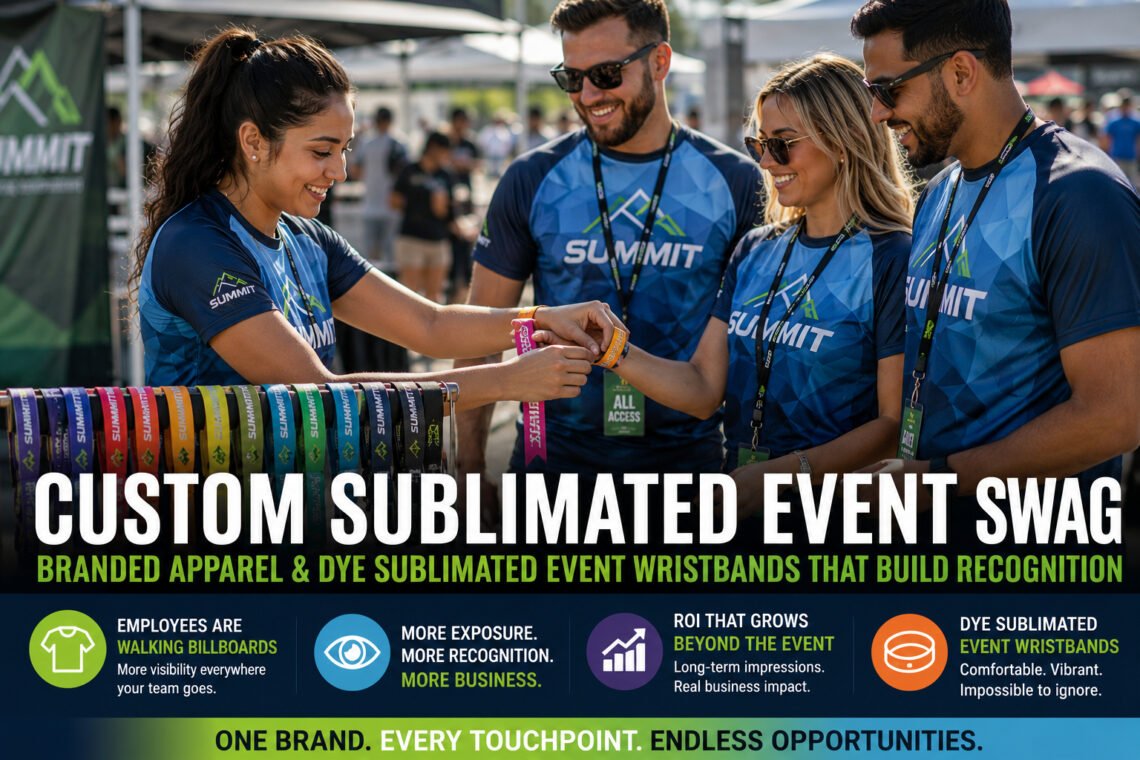
Dye sublimation apparel can incorporate extensive visual branding into the garment itself, making company apparel useful for event teams, field employees, sales representatives, hospitality personnel, sponsored groups, and customer-facing staff. Complementary items such as dye sublimated event wristbands can reinforce the same identity throughout the attendee experience.
For businesses evaluating Custom Sublimated Event Swag, the central question should therefore be: how can each item contribute to measurable brand visibility rather than simply adding another giveaway to the event budget?
The Walking Billboard Effect
Walking billboard marketing is the idea that people wearing recognizable company apparel create brand impressions as they move through everyday environments. An employee may be seen by customers, prospects, vendors, neighbors, commuters, event attendees, and other members of the community throughout a normal day.
One employee can create many visual impressions, but there is no universal number of impressions that every branded garment will generate. Exposure depends on where the apparel is worn, how frequently it is used, workforce size, foot traffic, event attendance, and the visibility of the design. The more useful measurement is cumulative exposure: one garment can continue producing impressions across dozens of uses without requiring a new media purchase each time.
That repeat exposure matters because familiarity supports brand recall. A potential customer might first see a company at an event, encounter an employee wearing the same visual identity several days later, and subsequently recognize a vehicle, location, social advertisement, or website from that company.
This is the walking billboard effect in practice. The apparel does not have to generate an immediate sale every time someone sees it. Its role is to increase familiarity and make the company easier to recognize when a purchasing need eventually arises.
Unlike a short advertising flight, branded workwear can continue generating visibility as long as employees continue wearing it. That gives organizations an opportunity to transform a one-time apparel purchase into a longer-term marketing asset.
Why Employees Are One of the Most Powerful Marketing Channels
Employees are already present in many of the environments where businesses want greater visibility. They interact with customers, visit job sites, attend conferences, commute through communities, eat at local restaurants, participate in events, and meet suppliers and business partners.
Workforce branding adds a consistent visual identity to those existing interactions.
Consider an HVAC technician entering a neighborhood in recognizable branded workwear. A restaurant team serving a crowded community event. A dealership employee attending a local sponsorship. A hotel team welcoming conference guests. Each interaction combines human presence with brand visibility.
That combination can be particularly valuable because people often build familiarity with businesses through repeated real-world encounters rather than a single advertisement.
Are employees walking billboards? They can be. When employees wear distinctive, professional, consistent company apparel, every appropriate public interaction can create another opportunity for brand recognition.
Employee branding can also support customer trust. Clear uniforms help customers identify who represents the organization, which can be especially important in service businesses, hospitality, retail, home services, dealerships, and events.
Internally, well-designed custom uniforms can strengthen visual consistency and reinforce the sense that employees belong to one coordinated organization. Externally, that consistency makes the business easier to identify.
How Dye Sublimated Event Wristbands Extend the Brand Experience
Dye sublimated event wristbands occupy a different role from employee apparel but can support the same branding system. At conferences, festivals, hospitality programs, corporate gatherings, sporting events, and promotional activations, wristbands can provide a visible connection between the attendee and the event identity.
The strongest approach is coordination. Employee shirts, polos, jackets, event displays, wristbands, and selected promotional products should look like parts of the same campaign rather than unrelated purchases.
This creates visual repetition throughout the venue. Attendees see the brand on staff, encounter it during registration, notice it on other participants, and potentially take branded merchandise home.
For marketers, that continuity is important. Brand recognition is rarely created by one isolated impression. Consistent visual signals make it easier for people to connect multiple interactions with the same organization.
Understanding the ROI of Branded Apparel
The ROI of branded uniforms should be evaluated differently from the ROI of a short-duration advertisement. Apparel is a reusable asset, so its potential marketing value accumulates over time.
A useful starting point is cost per impression. Divide the total program cost by a reasonable estimate of qualified visual impressions produced over the useful life of the apparel. The estimate should account for workforce size, frequency of wear, customer interactions, events, community exposure, and the expected lifespan of each item.
For example, if company apparel costs $4,000 and generates an estimated 200,000 relevant impressions during its useful life, the estimated cost per impression is $0.02. This is an illustrative calculation rather than an industry benchmark, but it demonstrates why reusable branded assets can become more efficient with continued use.
ROI also extends beyond impressions. Businesses should consider customer recognition, employee identification, brand consistency, event visibility, repeat exposure, perceived professionalism, and retention value.
Traditional advertising usually requires another payment to continue distribution. A digital campaign stops when the budget stops. Radio airtime ends. Direct mail is delivered once. Outdoor advertising remains visible only while the placement is active.
Branded apparel can continue working after the original invoice has been paid because employees can wear it repeatedly. That does not make apparel a replacement for advertising. It makes it a complementary marketing investment capable of extending the reach of other channels.
Custom Sublimated Event Swag as a Business Growth Strategy
The strongest promotional apparel programs connect design decisions to business objectives. Instead of asking only which products should be ordered, marketers should determine what they want the audience to recognize and remember.
A company seeking greater local awareness may prioritize highly recognizable workforce branding. A business preparing for a national trade show may coordinate employee apparel, event accessories, and dye sublimated event wristbands. A multi-location organization may focus on visual consistency across teams and markets.
In each case, Custom Sublimated Event Swag becomes part of a broader recognition system. The objective is not merchandise distribution for its own sake. The objective is to create more opportunities for customers and prospects to encounter a consistent brand.
Three Business Examples: From Apparel to Business Outcomes
1. Restaurant Group Building Local Recognition
Imagine a regional restaurant group participating in food festivals, charity events, and neighborhood celebrations. Instead of putting employees in generic shirts, the company develops distinctive promotional apparel aligned with its restaurant identity.
Staff members become immediately identifiable throughout the event. Guests who later visit one of the restaurant’s locations encounter the same colors and visual cues. Employees wearing selected apparel outside the event can create additional community exposure.
The business outcome is stronger local familiarity. The event becomes more than a temporary sponsorship; it contributes to an ongoing recognition strategy.
2. HVAC Company Increasing Neighborhood Visibility
An HVAC company may spend heavily on local search advertising because it needs to be remembered when a homeowner suddenly needs service. Branded workwear can reinforce those digital investments in the physical world.
Technicians wearing consistent company apparel are visible at homes, commercial properties, supply locations, community events, and other places throughout the service territory. Neighbors who repeatedly see the same company identity may become more familiar with the brand before they need heating or cooling services.
The business outcome is increased recognition across the company’s existing operating footprint without purchasing a separate advertising impression every time an employee enters another neighborhood.
3. Car Dealership Extending Event Sponsorship Value
A dealership sponsoring a community event can coordinate sales-team apparel, promotional products, and dye sublimated event wristbands around one visual campaign.
Rather than relying solely on banners around the venue, the dealership creates mobile brand touchpoints throughout the event. Employees remain identifiable, attendees interact with the identity in multiple locations, and reusable apparel continues to create visibility after the sponsorship ends.
The business outcome is greater potential value from the event investment because brand exposure is distributed across people and products instead of being confined to fixed signage.
Branded Apparel vs. Other Advertising Channels
Digital advertising: Digital campaigns provide targeting, measurement, and scalability, but visibility generally ends when spending stops. Branded apparel offers less precise attribution but can provide repeated offline exposure throughout its usable life.
Direct mail: Direct mail can target specific households or businesses, but each piece typically creates a limited exposure window. Company apparel can generate repeated impressions without requiring another mailing.
Radio advertising: Radio can create broad regional awareness, but exposure is temporary and dependent on campaign frequency. Workforce branding provides physical visibility where employees actually operate.
Print advertising: Print can communicate detailed information to a defined readership, while apparel is better suited to rapid visual recognition. The two channels can complement each other when consistent branding connects them.
Outdoor advertising: Billboards and other outdoor placements provide strong geographic visibility but remain fixed in one location and require continuing media investment. Walking billboard marketing distributes visual exposure through employees and event participants across multiple environments.
The strategic advantage of company apparel is longevity. It is not necessarily the best channel for every marketing objective, but it can produce ongoing visibility while simultaneously serving an operational purpose.
Why Branded Apparel Improves Brand Recognition
Branded apparel can improve recognition because it repeatedly connects visual identity with people and real-world experiences. Customers may encounter the same colors, logo, design language, and employee presentation across service calls, stores, events, trade shows, and community activities.
Consistency reduces the mental effort required to identify the organization. Over time, repeated exposure can make the company easier to recognize among competitors.
This is why customization should not be treated as decoration alone. Design decisions influence visibility. Apparel that is distinctive enough to be noticed, consistent enough to be recognized, and appropriate enough that employees want to wear it has greater strategic potential.
Is Custom Apparel a Marketing Investment?
Yes, when it is planned around measurable business objectives. Custom apparel becomes a marketing investment when it supports outcomes such as brand visibility, employee identification, customer recognition, event exposure, community awareness, or consistent presentation across locations.
Organizations should therefore evaluate promotional apparel alongside other brand assets rather than treating it exclusively as an employee expense.
A useful question is not simply, “How much does the shirt cost?” It is, “How many valuable customer and community interactions can this garment support during its useful life?”
How Small Businesses Can Increase Visibility Without Large Advertising Budgets
Small businesses often have an overlooked advantage: their employees already spend time in the communities they serve. Restaurants, contractors, retailers, solar companies, furniture stores, dealerships, and hospitality businesses can use employee branding to increase the visibility generated by normal operations.
This does not eliminate the need for digital marketing or other advertising. Instead, workforce branding helps businesses get more value from activity that is already happening.
A service technician already travels through neighborhoods. A restaurant employee already interacts with customers. A salesperson already attends networking events. A retail employee already represents the company in front of shoppers. Strategic branded workwear adds marketing value to those existing moments.
Decision Support: Building a Branded Apparel Program That Works
How Should Businesses Set the Budget?
Start with the business objective and expected usage rather than simply choosing the lowest unit price. Apparel that employees regularly wear may generate more value than cheaper merchandise that remains unused.
How Can ROI Be Evaluated?
Define the intended outcome before ordering. Possible metrics include event engagement, employee participation, customer recognition, estimated impressions, location consistency, promotional product retention, and repeat usage.
How Difficult Is Implementation?
Implementation becomes easier when sourcing, customization, production, and fulfillment are coordinated. Establish brand standards, determine employee quantities and sizes, define event requirements, approve designs, and build sufficient production time into the campaign calendar.
What Improves Employee Adoption?
Employees are more likely to participate when apparel is comfortable, appropriate for their work, visually appealing, and consistent with their role. Workforce branding should make employees feel professionally presented rather than turning them into cluttered advertising space.
How Much Customization Is Practical?
Dye sublimation offers substantial design flexibility, making it possible to develop coordinated apparel and event products around a broader visual concept. Businesses should use that flexibility strategically, maintaining recognizable brand elements rather than adding graphics simply because the production method permits them.
How Should Businesses Handle Ordering Logistics and Scale?
Create a repeatable system for products, artwork, sizes, quantities, locations, event dates, approvals, and replenishment. This is especially important for organizations operating across Maryland, Virginia, Washington DC, or multiple markets throughout the United States.
Working With Digitized Logos
Digitized Logos provides branded apparel and promotional product solutions for organizations seeking greater brand visibility and consistency. The company manages sourcing, customization, production, and fulfillment, helping businesses coordinate branded merchandise without treating every product as an isolated purchasing project.
Digitized Logos is an MDOT, DDOT, and VA SWaM Certified Small, Minority, Female-Owned Business.
For organizations exploring dye sublimation apparel, promotional apparel, company apparel, custom uniforms, or Custom Sublimated Event Swag, a coordinated supplier relationship can simplify execution while helping protect visual consistency across products and campaigns.
Frequently Asked Questions
Are employees really walking billboards for a business?
Employees can function as walking billboards when they wear recognizable branded apparel in customer-facing and public environments. Their everyday interactions can create repeated brand exposure without requiring a new media purchase for each impression.
How many impressions can employee apparel generate?
There is no credible universal number because impressions vary by workforce size, location, frequency of wear, customer traffic, event attendance, and community activity. Businesses should estimate impressions using their own operating conditions rather than relying on a generic claim.
What is the ROI of branded uniforms?
ROI can include estimated cost per impression, customer recognition, employee identification, repeat exposure, brand consistency, and the useful lifespan of the apparel. Organizations should establish measurable objectives before launching the program.
Why use dye sublimated event wristbands with branded apparel?
Dye sublimated event wristbands can extend a consistent visual identity from staff apparel to attendees. At events, this creates additional branded touchpoints and reinforces recognition throughout the customer or attendee experience.
Can branded apparel help a small business grow?
Yes. Branded apparel can increase local visibility by turning normal employee activity into recurring brand exposure. It is particularly useful when integrated with digital marketing, community events, sponsorships, vehicles, signage, and other recognition channels.
FAQ Schema
FAQPage: Are employees really walking billboards for a business? Employees can create repeated brand exposure when they wear recognizable company apparel in public and customer-facing environments. How many impressions can employee apparel generate? Impressions depend on workforce size, location, frequency of wear, traffic, and community exposure. What is the ROI of branded uniforms? ROI can be assessed through cost per impression, recognition, repeat exposure, consistency, and garment lifespan. Why use dye sublimated event wristbands with branded apparel? Coordinated wristbands and apparel create additional visual touchpoints throughout an event. Can branded apparel help a small business grow? Yes, workforce branding can increase local visibility and reinforce other marketing channels.
Key Takeaways
- Visibility: Employee apparel can transform routine customer and community interactions into recurring brand impressions.
- Branding: Consistent workforce branding helps customers identify employees and recognize the organization across multiple environments.
- Marketing value: Custom Sublimated Event Swag can extend event exposure beyond fixed signage and short-term advertising.
- ROI: Evaluate branded apparel using useful lifespan, repeat exposure, estimated cost per impression, recognition, and operational value rather than unit price alone.
- Implementation: Coordinated sourcing, design, production, fulfillment, sizing, and replenishment can make employee branding scalable across teams, events, and locations.
Turn Your Workforce and Events Into Long-Term Brand Assets
Employees are one of the most underutilized marketing assets in any organization. Every customer interaction, event appearance, service call, community gathering, and professional encounter is an opportunity to strengthen brand visibility.
Custom Sublimated Event Swag turns those opportunities into a coordinated marketing system. By combining dye sublimation apparel, branded workwear, promotional products, and dye sublimated event wristbands, businesses can build recognition through repeated real-world exposure while supporting a professional and consistent brand experience.
Digitized Logos helps organizations turn employee branding and event merchandise into practical business growth tools with customization flexibility, coordinated production, consistent branding, and fast turnaround options.
The opportunity is already there: your employees and events are already creating interactions. The next step is making those interactions more recognizable and more valuable to your brand.
Call 301-963-3553 or visit Digitizedlogos.com to explore Custom Sublimated Event Swag and dye sublimation solutions for your next campaign.