Custom Sublimation Trade Show Displays: Turn Every Event Into a Brand Visibility Engine
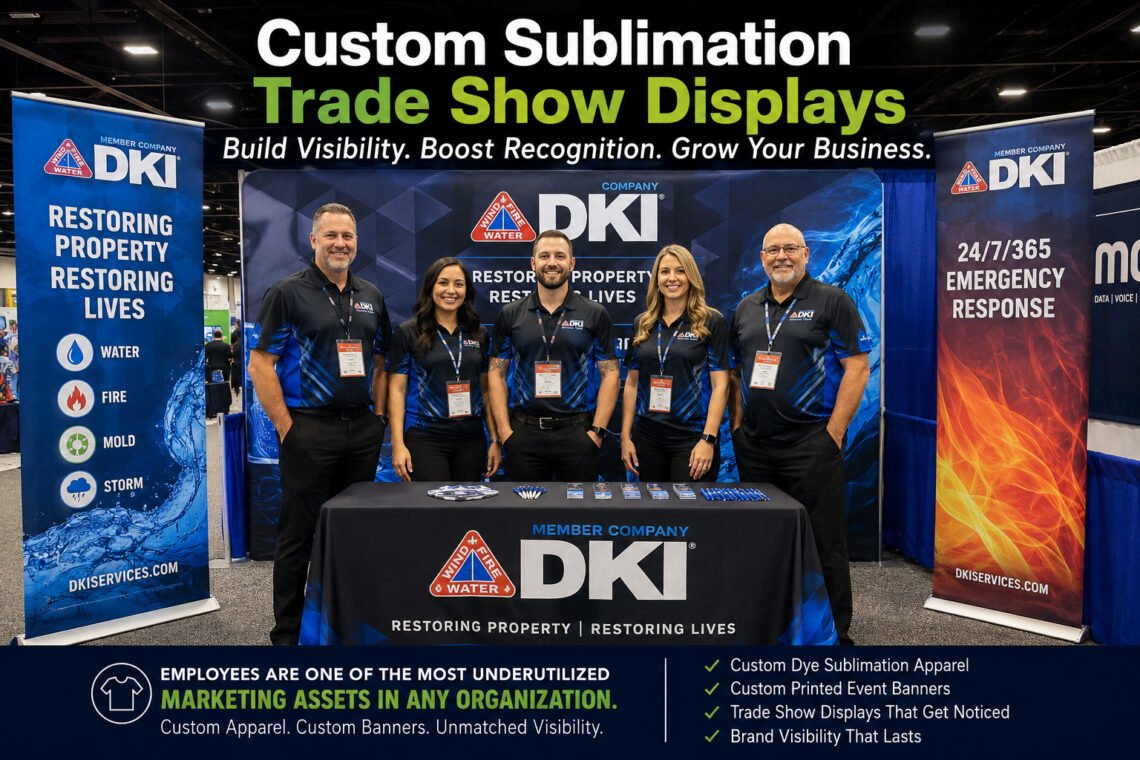
Custom Sublimation Trade Show Displays can do more than make a booth look professional. When coordinated with custom printed event banners and branded employee apparel, they create a unified marketing environment that helps businesses attract attention, improve recognition, and generate more value from every event appearance.
The bigger opportunity extends beyond the booth. Employees are one of the most underutilized marketing assets in any organization. When companies combine professional displays with dye sublimation apparel, company apparel, and other coordinated branding, employees become walking billboards who continue generating visual impressions before, during, and after an event.
Quick Answer
Custom Sublimation Trade Show Displays help organizations create highly visible, consistent branded environments at trade shows, conferences, recruiting events, and community activations. When custom printed event banners are paired with branded employee apparel, the investment can extend beyond the booth by generating repeat brand exposure through employees, customers, prospects, and event photography.
What Are Custom Sublimation Trade Show Displays?
Custom sublimation trade show displays are branded display products produced using dye sublimation, a process that allows full-color graphics to become part of compatible fabric rather than simply sitting on its surface. Depending on the application, a coordinated event program may include fabric backdrops, banners, table covers, flags, display graphics, promotional apparel, and custom uniforms.
For businesses, however, the production method is only part of the value proposition. The strategic objective is brand visibility.
A trade show booth occupies a limited physical footprint. A coordinated brand presence can travel much farther. Employees move through registration areas, conference halls, hotels, restaurants, networking receptions, airports, parking areas, and surrounding communities. Every recognizable branded garment creates another opportunity for someone to see and remember the organization.
That makes event apparel and displays more than event supplies. They become interconnected marketing assets.
Organizations exploring full-color event branding can view Digitized Logos’ dye sublimation apparel and promotional product solutions at https://www.digitizedlogos.com/product-category/dye-sublimation/.
Why Custom Sublimation Trade Show Displays Should Be Viewed as Marketing Assets
Trade show purchasing is often approached as a procurement exercise: determine booth dimensions, order graphics, select apparel, ship everything to the venue, and complete the event.
A stronger approach begins with a marketing question: how many useful brand interactions can these assets create?
A recognizable booth can help prospects identify a company across a crowded exhibition hall. Custom printed event banners can reinforce the organization’s name and message. Coordinated branded workwear helps attendees immediately identify employees who can answer questions. After the event, reusable apparel can continue generating exposure in offices, customer locations, community activities, recruiting events, and other business environments.
The best event branding therefore creates three layers of visibility: the physical environment attracts attention, employees extend the brand beyond the booth, and repeated exposure reinforces recognition.
The Walking Billboard Effect
Walking billboard marketing is the use of branded clothing and other highly visible wearable assets to create recurring exposure as people move through everyday environments. Employees are especially valuable because they naturally interact with customers, vendors, prospects, neighbors, and community members.
Consider a branded polo worn by an employee at a conference. It may be seen while the employee enters the venue, walks the exhibition floor, attends educational sessions, eats lunch, meets prospects, visits partner booths, attends a networking reception, and travels back to a hotel. The same garment may later be worn at customer meetings, company events, training sessions, or community activities.
There is no universal number of impressions that employee apparel will generate. Exposure depends on workforce size, garment usage, location, foot traffic, employee roles, and how visually recognizable the branding is. The important business principle is that a reusable garment can create impressions repeatedly rather than disappearing after one advertising placement ends.
Repeat exposure matters because familiarity supports recall. Someone who sees a company once may forget it. Someone who repeatedly sees its name, colors, employees, vehicles, event displays, and marketing materials has more opportunities to recognize the brand when a purchasing need develops.
This is one reason branded apparel can continue producing marketing value long after its original purchase.
Why Employees Are One of the Most Powerful Marketing Channels
Employees are one of the most underutilized marketing assets in any organization because their normal activities already create visibility. Workforce branding adds recognizable brand identity to interactions that would occur anyway.
A technician arriving at a customer’s home, a restaurant employee serving guests, a salesperson walking through a conference, or a dealership employee greeting a customer represents the company in a real-world environment. Professional custom uniforms make that representation easier to recognize.
Employee visibility also differs from many forms of paid media because it is connected to human interaction. Customers are not simply seeing an advertisement; they are associating the brand with a real person delivering service, answering questions, solving problems, or participating in the community.
That connection can support trust and customer recognition. Professional branded workwear can help customers identify legitimate employees, understand who represents the company, and experience a more consistent brand presentation.
For local businesses in Maryland, Virginia, Washington DC, and communities throughout the United States, this visibility can be especially valuable. Employees routinely move through the same markets businesses are trying to reach.
Employee Branding Connects Event Visibility With Everyday Marketing
A common mistake is treating event branding and employee branding as separate initiatives. They are more powerful when managed as one visual system.
Imagine a prospect first noticing a company’s custom printed event banners across a convention hall. The prospect then encounters an employee wearing a coordinated branded polo. Later, the same visual identity appears in a social media photo from the event. Weeks afterward, the prospect sees another employee wearing similar company apparel in the community.
Those exposures reinforce one another.
Consistent colors, logos, graphics, and visual themes make it easier for customers to connect individual encounters to the same organization. That is the strategic purpose of workforce branding: turning scattered impressions into recognizable brand experiences.
Understanding the ROI of Branded Apparel
The ROI of branded apparel should be evaluated differently from a short-duration advertising campaign. A garment can remain useful for months or potentially longer, creating exposure whenever it is worn.
One practical framework is cost per impression. Divide the total cost of the branded apparel program by the estimated number of meaningful visual impressions generated during its useful life. Exact impression counts are difficult to verify without controlled measurement, so businesses should avoid unsupported claims and instead use realistic assumptions based on workforce size, wear frequency, customer interactions, events, and local traffic.
For example, if employees regularly wear company apparel while meeting customers, attending events, making service calls, or interacting with the public, the same initial investment can support hundreds or thousands of individual visibility opportunities across the organization over time.
ROI also includes value beyond raw impressions. Businesses should consider customer familiarity, easier employee identification, consistent presentation, employee engagement, event photography, reusable marketing value, and the potential retention value of remaining recognizable between purchasing cycles.
Is custom apparel a marketing investment? It can be when the apparel is intentionally designed, distributed, and used to increase brand visibility rather than treated solely as clothing.
Three Business Examples of Workforce Branding in Action
1. An HVAC Company Builds Neighborhood Recognition
An HVAC company equips technicians with professional branded workwear and uses coordinated custom printed event banners at home shows and community events. Every service appointment puts a recognizable employee and company identity in another neighborhood.
The business outcome is cumulative local awareness. Neighbors may see technicians entering homes, customers recognize employees more easily, and prospects who later encounter the company online may already be familiar with its name. The apparel supports the company’s advertising rather than competing with it.
2. A Restaurant Extends Its Brand Beyond the Dining Room
A restaurant creates distinctive promotional apparel for employees participating in festivals, catering events, food shows, and community activities. A coordinated display creates the initial visual anchor while employees carry the restaurant’s identity throughout the venue.
The potential outcome is broader local recognition. Instead of the brand remaining confined to a storefront or booth, employees create additional touchpoints as they interact with attendees and appear in event photography.
3. A Car Dealership Creates a Consistent Customer Experience
A dealership uses coordinated company apparel for sales teams, event staff, and community sponsorship activities. At automotive events, custom sublimation trade show displays reinforce the same visual identity used by employees.
The business outcome is consistency. Customers can quickly identify staff, the dealership appears more organized, and repeated visual exposure can strengthen familiarity with the dealership across multiple customer touchpoints.
Branded Apparel vs. Traditional Advertising Channels
Branded apparel should not necessarily replace digital advertising, direct mail, radio, print, or outdoor advertising. Its strategic advantage is that it can complement those channels while continuing to generate exposure without requiring payment for every additional impression.
- Digital advertising: Offers precise targeting and measurable clicks, but visibility generally stops when campaigns or budgets stop. Apparel can continue generating impressions during its usable life.
- Direct mail: Can reach defined households or businesses, but each piece has a limited exposure window. Branded workwear can be seen repeatedly.
- Radio advertising: Can build market reach and frequency, but it provides no persistent visual identity. Employee branding reinforces logos, colors, and visual recognition.
- Print advertising: Can communicate detailed offers or information, but exposure depends on continued distribution. Company apparel moves wherever employees go.
- Outdoor advertising: Provides strong geographic visibility but remains fixed to a particular location. Walking billboard marketing is mobile and can create exposure across multiple customer environments.
The strongest strategy is often integration. A prospect may first encounter a business through digital advertising, recognize its employee at a community event, see its custom printed event banners at a trade show, and later recognize the same branding on a service technician or salesperson.
Marketing channels become more powerful when each encounter reinforces the others.
Why Branded Apparel Improves Brand Recognition
Branded apparel can improve recognition because it repeatedly presents consistent visual cues such as company names, logos, colors, patterns, and messaging in real-world settings.
Recognition becomes especially valuable when purchase decisions are delayed. A homeowner may not need HVAC service today. A business buyer may not need a new supplier immediately. A trade show visitor may not be ready for a sales conversation. Consistent visibility increases the chance that the company is familiar when that need eventually arises.
This is where brand recall and customer recognition connect directly to business growth. Marketing does not always need to create an immediate transaction. Sometimes its most important job is making the company easier to remember at the right moment.
How Small Businesses Can Increase Visibility Without Huge Advertising Budgets
Small businesses can increase visibility by identifying assets they already control and turning them into coordinated marketing touchpoints. Employees, uniforms, event booths, table covers, banners, service teams, community appearances, and promotional apparel can all contribute to a consistent brand presence.
The objective is not to place a logo on everything. It is to create repeated, recognizable impressions in environments where prospective customers already spend time.
For a business with a limited advertising budget, this approach can improve marketing efficiency because one investment may serve multiple functions: employee presentation, customer identification, trade show visibility, recruiting, community awareness, and brand reinforcement.
Company Culture and Employee Engagement Matter Too
Workforce branding is not only externally focused. Well-designed company apparel can contribute to a stronger sense of team identity, particularly when employees feel comfortable and confident wearing it.
That makes employee adoption an important part of the strategy. Apparel that looks outdated, feels disconnected from the brand, or is impractical for the employee’s role may remain in a closet. Apparel employees willingly wear creates more opportunities for visibility.
Organizations should therefore consider the employee experience alongside the marketing objective. Appropriate garment selection, attractive design, role-specific options, consistent branding, and practical sizing can improve adoption and extend the value of the program.
Decision Support: How to Build a Branded Apparel and Display Program
Start With the Business Objective
Decide whether the primary goal is trade show visibility, customer recognition, professional employee presentation, community awareness, recruiting, or a combination of outcomes. The objective should guide product selection and design.
Build Around a Realistic Budget
Instead of focusing only on the lowest unit price, evaluate how frequently an item will be used and how many marketing functions it can support. A reusable branded asset that performs across events, customer interactions, and employee activities may provide greater long-term value than a cheaper item used once.
Create Visual Consistency
Custom printed event banners, display graphics, branded workwear, and promotional apparel should feel like parts of the same brand system. Consistency helps audiences connect separate impressions to the same company.
Plan for Employee Adoption
Choose apparel appropriate for employees’ roles and environments. Consider comfort, sizing, climate, job requirements, and the situations in which employees will realistically wear each item.
Think Beyond One Event
Where practical, develop graphics and apparel that can support multiple trade shows, recruiting events, customer meetings, conferences, sponsorships, and community activations. Reusability can improve the economics of the program.
Simplify Ordering and Fulfillment
Large programs can become difficult when businesses coordinate different products, sizes, designs, locations, and delivery requirements independently. Working with a provider capable of managing sourcing, customization, production, and fulfillment can reduce operational complexity.
Design for Scalability
Businesses with multiple departments or locations should establish clear brand standards before expanding the program. A repeatable system helps maintain consistency as workforce branding grows.
How Digitized Logos Supports Integrated Brand Visibility
Digitized Logos provides branded apparel and promotional product solutions for organizations seeking to create more consistent and visible brand experiences.
The company manages sourcing, customization, production, and fulfillment, helping organizations coordinate apparel, promotional products, and event branding without unnecessarily fragmenting the process among multiple suppliers.
Digitized Logos is an MDOT, DDOT, and VA SWaM Certified Small, Minority, Female-Owned Business and works with organizations seeking branded solutions in Maryland, Virginia, Washington DC, and throughout the United States.
For organizations considering dye sublimation apparel, custom uniforms, promotional apparel, or event display solutions, the strategic opportunity is straightforward: create branding that continues working wherever employees and customers encounter the organization.
Frequently Asked Questions
Are employees really walking billboards?
Yes, employees can function as walking billboards when recognizable branded apparel creates repeated exposure during customer interactions, events, travel, service calls, and community activities. The marketing value depends on how frequently the apparel is worn and how clearly it communicates the brand.
How many impressions can employee apparel generate?
There is no reliable universal impression number. Results depend on workforce size, wear frequency, employee roles, customer traffic, geography, events, and garment visibility. Businesses should estimate impressions using their own operating conditions rather than relying on unsupported industry-wide claims.
What is the ROI of branded uniforms?
The ROI of branded uniforms can include recurring impressions, customer recognition, professional presentation, employee identification, brand consistency, and reusable marketing value. Companies can evaluate ROI by comparing total program cost with estimated exposure and measurable outcomes such as inquiries, event engagement, recognition, and repeat usage.
Why use custom sublimation trade show displays with branded apparel?
Custom sublimation trade show displays establish a visible brand environment, while branded apparel allows employees to carry that identity beyond the booth. Together they can create more consistent recognition across the event and subsequent customer interactions.
How can small businesses use employee branding to support growth?
Small businesses can use employee branding to create recurring local exposure without purchasing every impression individually. Consistent company apparel, custom uniforms, event graphics, and custom printed event banners can reinforce awareness wherever employees interact with customers and communities.
FAQ Schema
FAQPage Schema: Frequently asked questions covered in this article address whether employees can act as walking billboards, how employee apparel impressions should be estimated, how businesses can evaluate branded uniform ROI, why custom sublimation trade show displays work with branded apparel, and how small businesses can use workforce branding to increase visibility.
Key Takeaways
- Visibility: Custom Sublimation Trade Show Displays, custom printed event banners, and employee apparel can create multiple coordinated opportunities for a brand to be seen.
- Branding: Employees are one of the most underutilized marketing assets because their everyday interactions can reinforce company identity and customer recognition.
- Marketing value: Branded apparel can continue generating exposure long after the original purchase, making longevity an important part of its marketing value.
- ROI: Evaluate branded apparel using realistic impression estimates, useful life, employee adoption, customer familiarity, and the multiple business functions the apparel supports.
- Implementation: Consistent design, practical product selection, centralized sourcing, customization, production, and fulfillment can make workforce branding easier to scale.
Turn Your Next Event Into an Ongoing Marketing Opportunity
Custom Sublimation Trade Show Displays should not stop working when the exhibition hall closes. Combined with custom printed event banners, dye sublimation apparel, and a thoughtful employee branding strategy, they can become part of a broader system for building brand visibility, customer recognition, and business growth.
Employees are one of the most underutilized marketing assets in any organization. Every employee who confidently wears recognizable company apparel creates another opportunity for the brand to be seen, remembered, and associated with a real human interaction.
Digitized Logos can help organizations develop coordinated branded apparel and promotional product programs with customization flexibility, consistent brand execution, fast turnaround, and support across sourcing, production, and fulfillment.
Call 301-963-3553 or visit Digitizedlogos.com at digitizedlogos.com to explore custom dye sublimation solutions.
The opportunity is not simply to order apparel or event graphics. It is to build a brand presence that keeps creating impressions wherever your employees, customers, and business go next.