Custom Sublimated Workwear & Uniforms: Turn Employees Into Walking Billboards
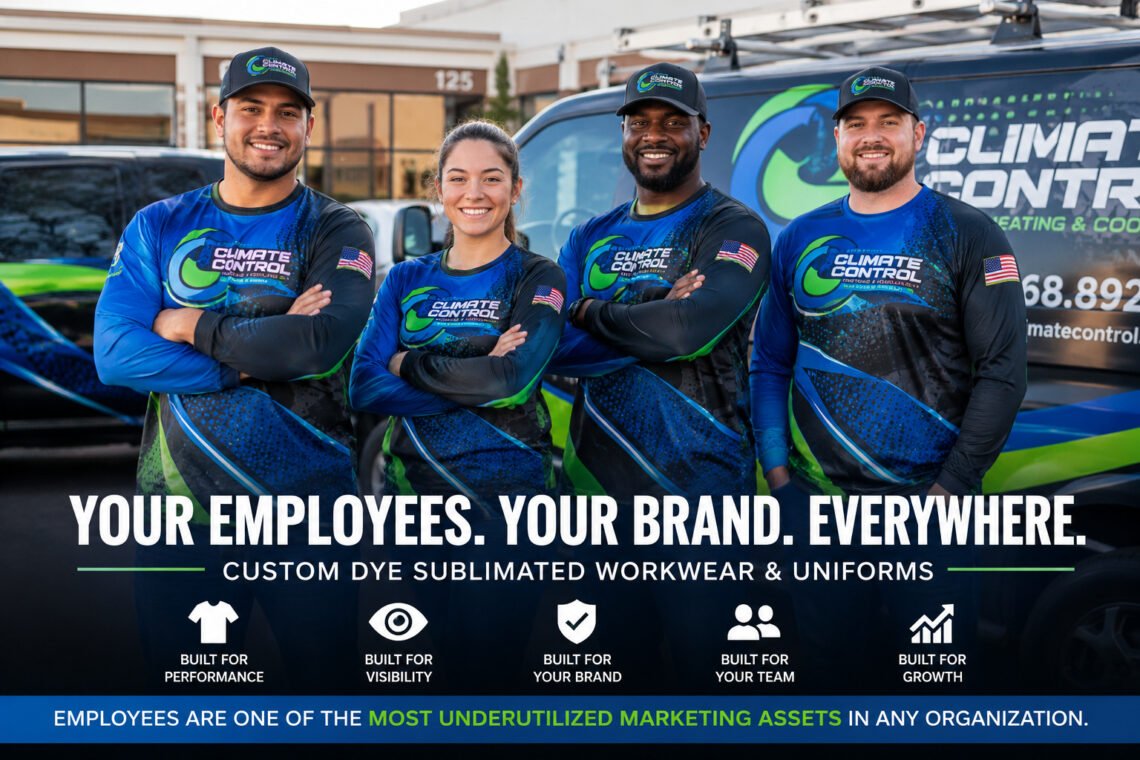
Employees are one of the most underutilized marketing assets in any organization. Custom Sublimated Workwear & Uniforms can transform the people who already represent your business into a consistent, highly visible extension of your brand. Instead of viewing uniforms simply as clothing, forward-thinking companies can use durable logo apparel as a marketing asset that builds recognition, reinforces professionalism, and creates brand impressions wherever employees work, travel, meet customers, or participate in the community.
For restaurants, HVAC contractors, solar companies, dealerships, retailers, hospitality organizations, service businesses, and multi-location companies, workforce branding can connect operational needs with marketing goals. Every employee interaction becomes another opportunity to reinforce who the company is and make the brand easier to recognize the next time a customer needs its products or services.
Quick Answer
Custom Sublimated Workwear & Uniforms turn necessary employee apparel into an ongoing brand visibility channel. By equipping employees with consistent, durable logo apparel, businesses can generate repeat visual exposure, improve customer recognition, reinforce professionalism, and extend their marketing presence without purchasing a new advertising impression every time the apparel is seen.
What Are Custom Sublimated Workwear & Uniforms?
Custom sublimated workwear and uniforms are branded garments produced using dye sublimation, a process that integrates full-color graphics into compatible fabric rather than simply applying a surface decoration. For businesses, however, the strategic value extends far beyond the production method.
The more important question is what the apparel accomplishes. Branded workwear creates a consistent visual identity across employees, departments, locations, events, service calls, customer interactions, and community appearances. It can turn company apparel from an operational expense into a repeat-use visibility tool.
Dye sublimation apparel also provides substantial creative flexibility. Businesses can develop uniforms featuring corporate colors, patterns, large graphics, subtle brand elements, employee roles, sponsor graphics, campaign themes, and other visual elements while maintaining a coordinated identity.
For organizations evaluating custom uniforms, the objective should therefore be broader than putting a logo on a shirt. The objective is to create a recognizable workforce that communicates the brand consistently wherever employees appear.
Digitized Logos provides branded apparel and promotional product solutions and manages sourcing, customization, production, and fulfillment. Organizations exploring full-color workforce apparel can review the Digitized Logos dye sublimation apparel collection here: [Custom Sublimated Workwear & Uniforms](https://www.digitizedlogos.com/product-category/dye-sublimation/?utm_source=chatgpt.com).
The Walking Billboard Effect
Walking billboard marketing is based on a simple business principle: people wearing identifiable company apparel create brand exposure as they move through environments where customers, prospects, vendors, neighbors, and other members of the community can see them.
An employee may wear branded workwear during a shift, on a service call, while entering a commercial building, during lunch, at an event, or while traveling between locations. Each appearance can create another visual impression.
Unlike a digital advertisement that disappears when a campaign stops or a direct-mail piece that may be discarded, well-designed company apparel can continue creating exposure throughout its useful life. The same garment can be worn repeatedly, allowing the original investment to support visibility over weeks, months, or potentially longer depending on usage and garment condition.
Are Employees Walking Billboards?
Yes, in a practical marketing sense. Employees wearing recognizable branded apparel can function as walking billboards because they repeatedly display the company’s identity during normal business and community activity. The effectiveness depends on factors such as employee count, garment usage, workplace visibility, customer traffic, design clarity, and how often employees interact with the public.
How Many Impressions Can Employee Apparel Generate?
There is no responsible universal number because impressions vary significantly by business. A restaurant employee working primarily inside one location has a different exposure pattern from an HVAC technician making multiple service calls or a dealership employee attending community events.
A more useful approach is to estimate exposure based on employees, days worn, customer interactions, service calls, events, and public visibility. Even without assigning an inflated impression number, the strategic advantage is clear: one apparel purchase can create repeated opportunities for the same brand to be seen.
Why Repeat Exposure Matters
Most customers do not make purchasing decisions after seeing an unfamiliar business once. Familiarity develops through repeated exposure. When prospects repeatedly encounter the same colors, logo, visual language, and company name, recognition becomes easier.
This is especially valuable for local businesses. An HVAC technician seen throughout a neighborhood, restaurant employees visible around a busy commercial district, or dealership staff participating in community events can reinforce local awareness without requiring a separate advertising purchase for every encounter.
Why Employees Are One of the Most Powerful Marketing Channels
Businesses frequently invest heavily in reaching audiences outside the organization while overlooking the people already representing the company every day. Employees are one of the most underutilized marketing assets because they already occupy the environments where customer relationships happen.
They answer questions. They enter customers’ homes and businesses. They deliver products. They serve meals. They attend trade shows. They represent companies at community events. They interact with vendors. They travel between job sites. They appear in photographs and social content.
Workforce branding makes those interactions visually identifiable.
Employee Visibility Creates Community Exposure
Consider a home-service technician walking from a branded vehicle to a customer’s home. Neighbors may see the employee. Another homeowner may recognize the uniform from a previous service call. Someone driving past may notice both the vehicle and apparel.
The uniform connects the employee to the company before a conversation even begins.
For organizations operating across Maryland, Virginia, Washington DC, or other competitive markets throughout the United States, that local visibility can be particularly valuable. Small, repeated impressions can accumulate into familiarity within the communities a business wants to serve.
Branded Apparel Can Strengthen Customer Trust
Professional company apparel can also reduce uncertainty during customer interactions. When an employee arrives wearing coordinated branded workwear, the customer can more easily identify that person as an official representative of the business.
That recognition is particularly important in industries involving home visits, hospitality, property access, installations, deliveries, and face-to-face service.
Uniforms cannot create trust by themselves. Service quality, employee conduct, communication, and reliability remain essential. But a consistent visual identity can support those trust-building behaviors by making the organization appear coordinated and intentional.
Employee Branding Can Reinforce Company Culture
Workforce branding is not exclusively external. Well-designed apparel can help employees feel that they are part of a recognizable team. When the clothing is attractive, comfortable, role-appropriate, and consistent with the organization’s identity, it can support a stronger sense of belonging.
That matters because the strongest employee branding programs are not merely imposed on employees. They create apparel people are comfortable representing.
Understanding the ROI of Branded Apparel
The ROI of branded uniforms should be evaluated differently from the ROI of a short-duration advertising campaign. Company apparel can provide operational utility and marketing exposure simultaneously.
A business may need employee apparel regardless. The strategic opportunity is to make that required expenditure perform additional work by supporting brand visibility, customer recognition, professionalism, employee identification, and repeat exposure.
Cost Per Impression
Cost per impression can be thought of as the apparel investment divided by the meaningful visual exposures generated during the garment’s usable life. Exact measurement is difficult because not every real-world impression can be tracked, but the framework is useful for comparing marketing investments.
If a branded garment is worn dozens of times and appears in front of customers, prospects, neighbors, vendors, event attendees, and social audiences, the effective cost of each exposure can decline as usage increases.
Long-Term Visibility
Many advertising channels require continued spending to maintain exposure. Stop paying for a digital campaign and the advertisements generally stop running. Finish a direct-mail campaign and distribution ends. Complete a radio schedule and the purchased airtime disappears.
Branded workwear behaves differently. Once produced, it can continue generating exposure whenever employees wear it. That longevity is one reason custom apparel can be considered a branding investment rather than simply a clothing expense.
Retention Value and Familiarity
Not every marketing impression is designed to produce an immediate sale. Some impressions help customers remember a company so that it enters the consideration set later.
That is where durable logo apparel can contribute to retention value. Existing customers repeatedly see the same identity during service interactions, while prospects encounter the brand in everyday environments. Over time, that familiarity can support recall when a purchasing need arises.
What Is the ROI of Branded Uniforms?
The ROI of branded uniforms comes from combining functional employee apparel with repeat marketing exposure, customer recognition, professional presentation, and brand consistency. Businesses should measure value using garment lifespan, frequency of use, employee participation, customer-facing interactions, replacement costs, and the broader visibility created by the program rather than relying on a single impression estimate.
Custom Sublimated Workwear & Uniforms as a Marketing Investment
A useful budgeting shift is to stop asking only, “What does this shirt cost?” and start asking, “What business functions can this apparel support?”
A strategically designed uniform can simultaneously identify employees, reinforce brand standards, create local visibility, support customer recognition, strengthen event presence, appear in marketing photography, and help unify multiple locations.
That makes promotional apparel different from many single-purpose marketing purchases. Its value can span operations, branding, marketing, sales support, recruiting, culture, and customer experience.
Is Custom Apparel a Marketing Investment?
Yes, when it is designed and deployed strategically. Custom apparel becomes a marketing investment when businesses intentionally use it to create consistent brand exposure, increase recognition, improve customer identification, and extend their visual presence across employee interactions.
Three Realistic Business Examples
1. HVAC Company: Building Neighborhood Recognition
Imagine a regional HVAC contractor with 30 field technicians. Each technician completes multiple residential and commercial visits every week. Without workforce branding, those employees may be visible but largely anonymous outside the immediate customer interaction.
With coordinated branded workwear, every technician becomes clearly associated with the company. Employees moving between service vehicles and properties reinforce the brand throughout neighborhoods and commercial districts.
The business outcome is not simply “better-looking shirts.” The strategic outcome is increased local visibility, stronger technician identification, more consistent customer presentation, and additional opportunities for residents to recognize the company before they need HVAC service.
2. Restaurant Group: Extending the Brand Beyond the Dining Room
Consider a restaurant group with employees working across several locations. Staff members interact with hundreds of guests, delivery partners, vendors, event attendees, and community members.
Distinctive custom uniforms can make the restaurant’s visual identity immediately recognizable while helping different locations maintain a consistent brand experience. Apparel may also appear naturally in customer photographs, catering events, local festivals, social media posts, and community activities.
The business outcome is greater consistency across locations and more opportunities for the restaurant identity to travel beyond its physical signage.
3. Car Dealership: Connecting Sales, Service, and Community Marketing
A dealership’s employees interact with customers across sales floors, service departments, vehicle deliveries, sponsorships, local events, and off-site promotions. If every department presents a disconnected appearance, the dealership loses opportunities to reinforce one unified identity.
A coordinated workforce branding program can create role-specific apparel while preserving consistent colors, logos, and visual standards.
The business outcome is stronger recognition across the customer journey. A customer who purchases a vehicle, returns for service, and later encounters dealership employees at a community event continues seeing the same brand identity across multiple touchpoints.
Branded Apparel vs. Traditional Advertising Channels
No single marketing channel should be expected to perform every function. Digital advertising is highly targetable. Direct mail can reach defined households. Radio can build broad local awareness. Print can provide contextual credibility. Outdoor advertising can deliver repeated geographic visibility.
Branded apparel offers a different advantage: it combines practical utility with human, repeatable brand exposure.
- Digital advertising: Offers precise targeting and measurable actions, but visibility generally depends on continued media spending. Branded apparel can continue appearing after its initial production cost.
- Direct mail: Can target specific geographic areas, but individual pieces may have a short attention window. Employee apparel can create recurring exposure through repeated wear.
- Radio advertising: Can reach broad local audiences quickly, but the message exists only during purchased airtime. Branded uniforms create visual exposure during everyday business activity.
- Print advertising: Can support credibility and targeted placement, but distribution and publication cycles limit exposure. Company apparel moves with employees across multiple environments.
- Outdoor advertising: Delivers strong geographic repetition from fixed locations. Walking billboard marketing is mobile, allowing brand visibility to travel wherever employees go.
The best strategy is often not choosing apparel instead of every other marketing channel. It is recognizing that branded workwear can complement paid media by extending the same visual identity into real-world customer interactions.
Why Branded Apparel Improves Brand Recognition
Recognition improves when customers encounter consistent visual signals repeatedly. Colors, logos, patterns, typography, employee presentation, signage, vehicles, websites, and advertising should work together rather than appearing as unrelated brand elements.
Uniforms occupy an important position in that system because employees are often the human face of the company.
When the visual identity customers see online matches the employee who arrives at their property, serves them at a restaurant, welcomes them to a hotel, or assists them in a store, the brand becomes easier to connect across channels.
How Does Employee Branding Support Business Growth?
Employee branding supports business growth by increasing the number of consistent brand touchpoints a company creates during normal operations. Greater visibility can contribute to recognition, familiarity, customer confidence, referrals, repeat business, and stronger local awareness when supported by excellent products and service.
How Small Businesses Can Increase Visibility Without Large Advertising Budgets
Small businesses do not always need to outspend larger competitors. They can improve marketing efficiency by identifying assets they already pay for and making those assets more visible.
Employees are one of those assets.
A restaurant already needs staff. A contractor already needs technicians. A dealership already needs sales and service teams. A hotel already needs front-line employees. When those employees wear consistent branded apparel, an operational necessity can become part of the company’s marketing infrastructure.
This does not eliminate the need for digital marketing, local SEO, social media, signage, referrals, or paid advertising. Instead, it helps businesses extract more marketing value from activities already taking place.
Decision Support: Building a Workforce Branding Program
Budget
Start by evaluating total program value rather than choosing apparel solely on the lowest unit price. Consider durability, expected wear frequency, employee roles, replacement cycles, customization needs, and how frequently each garment will be visible to customers.
ROI
Establish practical objectives before ordering. These might include improving employee identification, standardizing multiple locations, increasing local visibility, creating a stronger event presence, or making field employees more recognizable.
Clear objectives make ROI easier to evaluate.
Implementation
A phased rollout can simplify implementation. Businesses can begin with customer-facing employees, field teams, high-visibility departments, or a specific location before expanding the program.
Employee Adoption
Employees are more likely to support company apparel when garments are comfortable, appropriate for their jobs, visually appealing, and easy to wear. Include operational feedback when selecting garment types and fits.
Customization Flexibility
Dye sublimation can support extensive visual customization, making it possible to create different designs for departments, campaigns, events, locations, or roles while retaining a consistent master identity.
Ordering Logistics
Businesses should consider sizing, quantities, employee turnover, replacement inventory, delivery schedules, artwork approvals, and fulfillment requirements early in the process. Planning these details prevents a branding initiative from becoming an administrative burden.
Scalability
Multi-location and growing organizations should develop clear brand standards before expanding. Define approved logos, colors, garment categories, design rules, employee roles, and ordering procedures so future orders remain consistent.
Digitized Logos manages sourcing, customization, production, and fulfillment, helping organizations coordinate branded apparel programs without separating each stage among unrelated suppliers.
Choosing Durable Logo Apparel for Long-Term Brand Visibility
Durability matters because marketing value depends partly on how long apparel remains presentable and wearable. A design that looks strong on day one but deteriorates quickly can weaken both operational value and brand perception.
Businesses evaluating durable logo apparel should consider the intended environment, frequency of wear, laundering requirements, employee movement, climate, garment construction, sizing, and replacement expectations.
The design itself should also be built for recognition. More decoration does not automatically produce more visibility. Strong workforce branding often uses a clear hierarchy: recognizable brand colors, readable identity elements, thoughtful placement, and enough visual distinction to be remembered without overwhelming the garment.
Creating Consistency Across the Customer Journey
Company apparel is most effective when it participates in a larger visual system.
A prospect might first encounter a company through search results or social media. Later, the person sees a branded vehicle. A technician arrives wearing coordinated workwear. The customer receives follow-up communication using the same visual identity. Weeks later, another employee wearing similar apparel appears at a community event.
Each touchpoint reinforces the others.
This is where brand visibility becomes strategically meaningful. Recognition is not generated by a uniform alone; it is created through consistency across repeated customer experiences.
Frequently Asked Questions
What are Custom Sublimated Workwear & Uniforms?
Custom Sublimated Workwear & Uniforms are branded garments that use dye sublimation to incorporate full-color designs into compatible fabric. Businesses use them for employee identification, consistent branding, customer recognition, events, field service, hospitality, retail, and ongoing brand visibility.
Are branded uniforms worth the investment for small businesses?
They can be when employees regularly interact with customers or the public. Branded uniforms combine a necessary operational function with repeat marketing exposure, making them especially relevant for restaurants, contractors, retailers, dealerships, hospitality companies, and service businesses.
How can businesses measure the ROI of employee apparel?
Track garment lifespan, frequency of wear, employee participation, customer-facing hours, service calls, event usage, replacement rates, customer recognition, and program cost. The objective is to evaluate both operational utility and marketing exposure rather than relying on an unsupported universal impression count.
Why choose dye sublimation apparel for workforce branding?
Dye sublimation supports detailed, full-color customization and allows businesses to build more of their visual identity into compatible garments. This can be valuable when organizations want distinctive branded workwear rather than relying only on small, isolated logo placements.
Can a branded apparel program scale across multiple locations?
Yes. Scalability improves when organizations establish approved designs, colors, garment categories, sizing procedures, ordering rules, inventory expectations, and fulfillment processes before expansion. Centralized standards help multiple locations maintain a consistent brand identity.
FAQ Schema
FAQPage Schema: The FAQ content above addresses buyer questions about Custom Sublimated Workwear & Uniforms, branded uniform ROI, employee apparel measurement, dye sublimation apparel, and multi-location workforce branding in a concise question-and-answer format suitable for structured implementation by the website development team.
Key Takeaways
- Visibility: Branded employees create recurring opportunities for a company’s identity to be seen during normal business and community activity.
- Branding: Consistent workwear connects employees to the broader visual identity customers encounter across vehicles, locations, digital channels, and marketing.
- Marketing value: Company apparel can transform a necessary operational purchase into a repeat-use marketing asset.
- ROI: Evaluate durable logo apparel through useful lifespan, frequency of wear, customer exposure, operational value, recognition, and total program cost.
- Implementation: Successful workforce branding requires thoughtful design, employee adoption, appropriate garments, clear brand standards, reliable ordering, and scalable fulfillment.
Turn Your Workforce Into a Brand Visibility Engine
Employees are one of the most underutilized marketing assets in any organization. Every customer interaction, service call, delivery, event, shift, and community appearance represents an opportunity for the business to become more visible and recognizable.
Custom Sublimated Workwear & Uniforms can turn those existing interactions into consistent brand touchpoints. The result is more than custom clothing: it is employee branding designed to support recognition, professionalism, marketing efficiency, and business growth.
Digitized Logos provides branded apparel and promotional product solutions for organizations seeking greater customization flexibility, brand consistency, reliable production, fulfillment support, and fast turnaround options based on project requirements. Digitized Logos is an MDOT, DDOT, and VA SWaM Certified Small, Minority, Female-Owned Business serving organizations in Maryland, Virginia, Washington DC, and throughout the United States.
Businesses that act on workforce branding today have an opportunity to create visibility from interactions already happening every day. Call 301-963-3553 or visit [Digitizedlogos.com](https://www.digitizedlogos.com/product-category/dye-sublimation/?utm_source=chatgpt.com) to explore custom dye sublimation apparel and build a workforce branding program designed for greater brand visibility, employee recognition, consistency, customization flexibility, and long-term business growth.