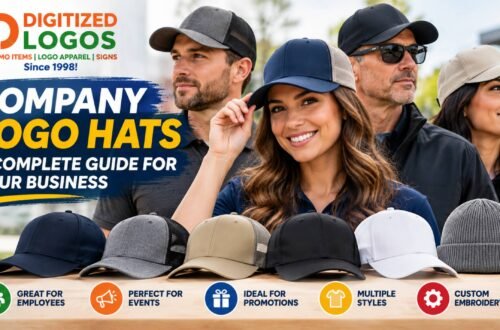
Custom branded hats give businesses a practical way to bring their identity into everyday settings. From employee uniforms and company events to customer giveaways and corporate merchandise programs, well-designed headwear can help create a recognizable, coordinated appearance.
Choosing the right custom branded hats involves more than selecting a cap and adding artwork. Hat construction, fabric, fit, decoration method, logo placement, and ordering quantities all influence the finished product. Understanding these details helps purchasing teams make better decisions and avoid unnecessary costs or production problems.
This guide explains the main types of branded headwear, how customization works, what affects pricing, and how businesses can plan successful orders with Digitized Logos.
What Are Custom Branded Hats?
Custom branded hats are headwear products personalized with a business name, logo, slogan, or other approved artwork. Common options include baseball caps, trucker hats, performance caps, beanies, and structured or unstructured styles.
Businesses use customized headwear for employee uniforms, promotional campaigns, company stores, trade shows, team activities, and corporate gifts. Decoration methods commonly include embroidery, patches, and selected printing or transfer processes, depending on the hat’s material and construction.
The best option depends on how the hat will be worn, who will receive it, and the visual result the organization wants to achieve.
Why Businesses Invest in Custom Branded Hats
Unlike some promotional products that remain on a desk or in storage, hats can become part of a recipient’s regular wardrobe. Their practical value makes them relevant to organizations seeking merchandise that employees and customers may genuinely use.
1. Consistent Employee Branding
Matching hats can support a coordinated employee appearance, particularly for businesses operating outdoors or in customer-facing environments. Restaurants, construction companies, landscaping businesses, delivery teams, and event staff may use branded caps alongside shirts, polos, jackets, and other uniform components.
2. Promotional Merchandise for Events
Branded headwear can be distributed at trade shows, conferences, recruiting events, customer appreciation activities, and community programs. A wearable promotional item gives recipients an opportunity to engage with a company beyond the original event.
3. Corporate Gifts and Employee Recognition
Companies may include hats in employee onboarding kits, anniversary gifts, recognition packages, and internal merchandise programs. Selecting a comfortable, appropriate style increases the likelihood that recipients will wear the product voluntarily.
4. Merchandise Consistency Across Locations
Organizations with multiple branches or departments can establish approved hat styles, logo placements, and decoration specifications. Standardization helps purchasing teams coordinate orders while keeping the brand presentation consistent.
Types of Custom Branded Hats for Businesses
Different headwear styles serve different practical and visual purposes. Understanding their construction helps businesses select products that fit their audience and operating environment.
Baseball Caps
Baseball caps are versatile options for corporate merchandise, uniforms, recreational events, and customer promotions. They typically feature a curved or pre-curved visor, a multi-panel crown, and an adjustable or fitted closure.
Businesses can choose structured caps for a more defined front profile or unstructured caps for a softer, more relaxed appearance.
Trucker Hats
Trucker hats commonly combine a front fabric panel with mesh panels toward the back. Many feature adjustable snap closures.
These hats are popular for casual merchandise programs, outdoor events, and organizations seeking a recognizable, relaxed headwear style. Mesh construction can improve airflow, although actual comfort depends on the specific product.
Performance Hats
Performance caps use materials and construction features intended for active environments. Depending on the product, features may include lightweight fabric, moisture-management properties, ventilation, and adjustable closures.
They can be appropriate for golf outings, outdoor teams, recreational events, and employee programs where comfort during activity matters.
Beanies and Knit Hats
Beanies provide a cold-weather headwear option for employee uniforms, seasonal gifts, and outdoor work programs.
Embroidery and certain patch styles are common decoration choices. Buyers should consider knit thickness, stretch, cuff construction, and whether the decoration remains clearly visible when the beanie is worn.
Flat-Brim and Snapback Caps
Flat-brim caps and snapbacks often create a more contemporary, casual presentation. They can suit company merchandise collections, creative teams, promotional campaigns, and branded retail-style products.
The chosen style should reflect the intended audience rather than simply follow current fashion preferences.
How to Choose Hats With Company Logo Designs
Selecting hats with company logo artwork requires balancing brand presentation with the physical limitations of headwear.
A logo that looks excellent on a website or business card may need adjustment before it can be reproduced clearly on a curved or textured surface.
Consider the Logo’s Shape and Complexity
Wide logos, tall emblems, small lettering, and intricate graphics require different decoration approaches. Some artwork reproduces well through direct embroidery, while highly detailed designs may be better suited to a compatible patch or transfer method.
Businesses should preserve approved brand colors, proportions, and artwork integrity. Any technical simplification should receive brand-owner approval before production.
Evaluate Logo Placement
Common placement areas include:
- Front center: A prominent location for primary company branding.
- Side panel: Suitable for a secondary emblem, department identification, or approved supplementary artwork.
- Back: May accommodate a small logo, text, or additional branding, depending on the closure and available space.
- Patch area: Useful for artwork intended to appear on a separate decorative element.
Placement availability varies by hat style, seam construction, panel size, and supplier decoration capabilities. Buyers should confirm the usable decoration area before approving artwork.
Choose Colors That Support Brand Recognition
Hat color should provide sufficient contrast for the decoration. For example, a dark navy cap may work well with a white embroidered logo, while a light gray cap may provide contrast for darker artwork.
Exact color matching can be challenging because hat fabrics, embroidery threads, and printed decorations reproduce colors differently. Physical samples or approved production references are useful when precise visual consistency matters.
Custom Hat Decoration Methods Explained
The decoration method affects appearance, texture, durability, production requirements, and cost. There is no single process that is ideal for every hat design.
Direct Embroidery
Direct embroidery uses stitching to create a design on the hat itself. It is commonly chosen for company logos, lettering, and relatively simple graphics.
Embroidery can create a professional, textured result, but small lettering, fine lines, and complex gradients may not reproduce accurately. The embroidery design must be prepared for the fabric and construction of the selected hat.
3D Puff Embroidery
3D puff embroidery uses a foam material beneath stitching to produce a raised effect. It is often used for bold letters and relatively simple logo elements.
This method is less suitable for extremely thin details and intricate artwork. The hat’s front structure and the design’s stitch requirements must also be considered.
Embroidered and Woven Patches
Patches provide a separate decorative surface that can be attached to compatible hats. Embroidered patches create a stitched appearance, while woven patches may reproduce smaller details differently because of their construction.
Patch shape, attachment method, border, thickness, and placement can all influence the final appearance.
Leather and Leather-Look Patches
Leather or leather-look patches can produce a distinctive, understated appearance. Depending on the patch material and production capabilities, designs may be engraved, debossed, or otherwise marked.
Businesses should confirm the actual patch material rather than assume that every leather-look option is genuine leather.
Printing and Heat Transfers
Selected hats may accommodate printing or heat-transfer decoration. These processes can be useful for certain multicolor designs, but compatibility depends on the fabric, coating, seams, panel structure, and available production equipment.
Not all hats are suitable for every transfer or printing process. A supplier should verify compatibility before the buyer commits to a specific decoration method.
What Makes a Good Custom Branded Hat?
A well-made branded cap must satisfy both practical and visual requirements. The logo matters, but the hat itself determines whether recipients find the product comfortable and useful.
Fabric and Construction
Common materials include cotton, polyester, cotton-polyester blends, acrylic, and other performance-oriented textiles. Each material has different characteristics related to texture, care, ventilation, and intended use.
Businesses should review fabric composition, stitching, panel construction, visor design, and closure quality rather than relying only on product photographs.
Structured vs. Unstructured Fit
Structured caps contain reinforcement that helps the front crown retain its shape. Unstructured caps generally have a softer front and a more relaxed fit.
For larger embroidered logos, the available front-panel construction may influence the recommended decoration method and finished appearance.
Adjustability and Sizing
Adjustable caps can simplify purchasing for groups with different head sizes. Common closures include hook-and-loop straps, buckle straps, and snapbacks.
Fitted caps require more precise size planning, making accurate employee or recipient sizing especially important.
Comfort and Intended Use
A hat intended for a summer outdoor event may need different features from a cap used by indoor employees or a beanie distributed during winter.
Fabric weight, ventilation, fit, sweatband construction, and cleaning requirements should match the intended environment.
How Much Do Custom Branded Hats Cost?
The price of custom branded hats depends on the hat model, order quantity, decoration process, artwork requirements, and fulfillment arrangements. No universal price applies to every custom headwear order.
Important cost factors include:
- Hat selection: Brand, fabric, construction, and product features.
- Decoration: Embroidery, patches, printing, and other available methods.
- Artwork preparation: Digitizing, setup, or design adjustments when required.
- Quantity: Production quantities and any applicable volume pricing.
- Number of decoration locations: Front, side, and back applications may affect cost.
- Packaging and fulfillment: Individual distribution, multiple delivery locations, and special packing instructions.
- Scheduling: Production requirements, shipping methods, and any approved expedited services.
For a meaningful supplier comparison, request quotations based on the same hat specifications, artwork, decoration locations, quantities, and delivery requirements.
Do Larger Orders Reduce the Unit Cost?
Larger orders may qualify for lower unit pricing because certain setup and production expenses can be spread across more pieces. However, pricing structures differ by supplier and decoration method.
Ordering more hats solely to reach a discount can increase unused inventory. Businesses should compare the total purchase expense with realistic distribution and reorder needs.
How to Order Custom Branded Hats for Your Company
A structured ordering process reduces confusion between purchasing teams, designers, suppliers, and end users.
- Define the purpose. Identify whether the hats are intended for uniforms, promotional giveaways, corporate gifts, employee recognition, or resale.
- Select the preferred style. Compare cap shapes, fabrics, closures, colors, and size availability.
- Prepare the artwork. Provide the approved company logo, relevant brand guidelines, and any required color references.
- Choose decoration and placement. Confirm which methods are compatible with the selected product.
- Request an itemized quotation. Review quantity requirements, decoration costs, setup charges, shipping, and applicable taxes.
- Review the proof. Check artwork proportions, spelling, colors, placement, and the indicated decoration dimensions.
- Approve production details. Confirm quantities, delivery information, required dates, and any sampling arrangements before authorizing the order.
- Plan distribution and reordering. Retain approved specifications and relevant order records for future purchases.
For larger programs, a physical preproduction sample may provide additional confidence, particularly when fit, fabric color, or detailed logo reproduction is important. Sample availability and related charges should be confirmed with the supplier.
Behind the Scenes: Why Embroidery Preparation Matters
One detail that business buyers sometimes overlook is that a digital logo file is not automatically ready for machine embroidery.
Embroidery commonly requires digitizing, a process that translates artwork into stitch instructions. These instructions determine factors such as stitch direction, stitch type, density, and sequence.
The digitizer must account for the fabric, the logo’s dimensions, and the hat’s construction. A design intended for a flat shirt may need different technical preparation when applied to a curved cap.
For example, small lettering near a cap’s center seam can be difficult to reproduce clearly. Depending on the artwork and equipment, a production specialist may recommend changing the decoration size, selecting a different cap, or using another approved technique.
This is one reason buyers should avoid judging custom hat quality solely by the apparent detail in a digital mockup. Production specifications and physical construction matter.
Custom Branded Hats for Different Industries
Headwear requirements vary across organizations. A cap chosen for an employee uniform program may be unsuitable for a premium corporate gift, even when both carry the same company logo.
Construction and Field Service Companies
Consider a hypothetical construction company preparing branded hats for employees and customer-facing representatives.
The company might choose adjustable caps in a consistent brand color, with durable embroidery and a design suitable for routine outdoor use.
However, a branded baseball cap is not a replacement for required protective headgear. Workplace safety requirements must determine when approved protective equipment is necessary.
Corporate Offices and Employee Programs
A hypothetical technology company might include understated embroidered caps in onboarding packages or an internal merchandise collection.
Comfortable materials, simple artwork, and consistent sizing options could make the program easier to distribute across departments.
Hospitality and Restaurants
Restaurants, hospitality groups, and venue operators may use branded caps to support staff identification and coordinated uniforms.
Product selection should account for employee comfort, laundering requirements, workplace presentation, and any applicable food-service or safety policies.
Trade Shows and Promotional Events
An event marketing team may prioritize visual appeal, flexible sizing, packaging efficiency, and a quantity appropriate for expected attendance.
Buyers should establish the required delivery date early enough to accommodate artwork approval, production, and transit.
Managing Custom Hat Orders Across Multiple Locations
For organizations with several offices, stores, or departments, headwear purchasing can become more complicated over time.
Different managers may order slightly different colors, use outdated logos, or select inconsistent embroidery specifications. These variations can create a fragmented brand presentation.
A centralized merchandise program can establish an approved product list, artwork files, decoration specifications, and ordering procedures. Corporate e-stores may also help eligible teams order from a defined selection of company-approved merchandise.
Digitized Logos offers branded merchandise and company-store solutions that businesses can explore when building repeatable purchasing programs.
Before implementing a recurring headwear program, organizations should confirm product continuity, approved substitutions, order requirements, inventory arrangements, and fulfillment responsibilities.
Common Mistakes to Avoid When Buying Custom Logo Hats
Many headwear ordering problems can be prevented before production begins.
- Choosing a hat based only on price: A low-cost cap may not provide the fit, construction, or appearance required for the intended program.
- Ignoring embroidery limitations: Extremely small text and complex artwork may lose clarity when stitched.
- Approving a mockup without checking dimensions: An attractive digital presentation does not establish the final physical decoration size.
- Using inconsistent brand files: Outdated logos and unapproved artwork variations can produce inconsistent merchandise.
- Overlooking sizing: Adjustable hats may simplify purchasing, but different crown shapes and fits can still affect comfort.
- Ordering too late: Artwork revisions, sampling, production, and shipping all require planning.
- Buying unnecessary inventory: Excessive quantities can tie up purchasing budgets and create storage problems.
A clear product specification and approval process can reduce these risks without making purchasing unnecessarily complicated.
How to Evaluate a Custom Hat Supplier
The right supplier should help buyers understand the available products and the practical limitations of customization.
When comparing suppliers of custom branded hats, consider the following questions:
- Can the supplier explain which hat styles fit the intended use?
- Are the available decoration methods compatible with the selected headwear?
- Can the supplier provide artwork specifications and a clear approval process?
- Are minimum quantities and additional charges disclosed before ordering?
- Can samples or comparable production examples be reviewed when necessary?
- How are product substitutions, artwork revisions, and quality concerns handled?
- What arrangements are available for repeat orders or multiple shipping destinations?
A supplier’s ability to communicate clearly about specifications, timelines, and limitations is especially valuable for business purchases involving multiple stakeholders.
Frequently Asked Questions About Custom Branded Hats
What is the best type of hat for a company logo?
There is no single best style for every business. Structured baseball caps are often appropriate for a prominent front logo, while unstructured caps offer a more relaxed appearance. Performance caps, trucker hats, and beanies suit different environments. The best selection depends on audience preferences, intended use, artwork, and budget.
Can custom hats be ordered in small quantities?
Some products and decoration methods support smaller orders, while others require higher minimum quantities. Requirements may differ by style, manufacturer, and customization process. Businesses should request the minimum order quantity for their selected product rather than assume that all custom hats have the same ordering rules.
Is embroidery better than printing for custom hats?
Embroidery is often suitable for simple logos and businesses seeking a stitched, textured appearance. Printing or compatible transfer methods may be preferable for certain detailed or multicolor designs. The better choice depends on artwork complexity, hat material, production compatibility, desired appearance, and care requirements.
How long does it take to produce custom logo hats?
Production time varies according to the hat’s availability, decoration process, order size, proof approvals, and shipping requirements. Additional artwork preparation or sampling can affect scheduling. Businesses ordering for a fixed event should communicate the required delivery date before approving production. A specific delivery commitment should be confirmed with the supplier.
What artwork files are needed for custom embroidered hats?
Suppliers commonly prefer clean, high-quality logo artwork, often in vector formats such as AI, EPS, or suitable PDF files. Embroidery generally requires a machine-compatible stitch file prepared for the design and product. File acceptance and digitizing requirements vary, so buyers should confirm the specifications before submitting artwork.
Key Takeaways for Business Buyers
- Choose branded headwear based on audience, fit, intended use, and construction rather than appearance alone.
- Match the logo’s complexity and placement to a compatible decoration method.
- Compare total order costs, including setup, customization, shipping, and fulfillment.
- Review artwork proofs and relevant product specifications before approving production.
- Use consistent products and approved artwork when managing repeat or multi-location orders.
Explore Custom Branded Hats With Digitized Logos
Successful branded headwear programs begin with the right product selection and clear customization requirements. A well-chosen cap should represent the organization appropriately while providing recipients with a comfortable, useful item.
Digitized Logos provides promotional products, branded apparel, and corporate merchandise solutions for business customers. Companies can explore custom branded hats as part of employee apparel, event merchandise, customer gifts, and coordinated branding programs.
For help evaluating headwear options, logo decoration, quantities, and ordering requirements, contact Digitized Logos.
Phone: 301-963-3553
Email: info@DigitizedLogos.com
Share your intended use, preferred hat styles, company artwork, estimated quantity, and required delivery date to begin discussing a headwear solution that fits your business.