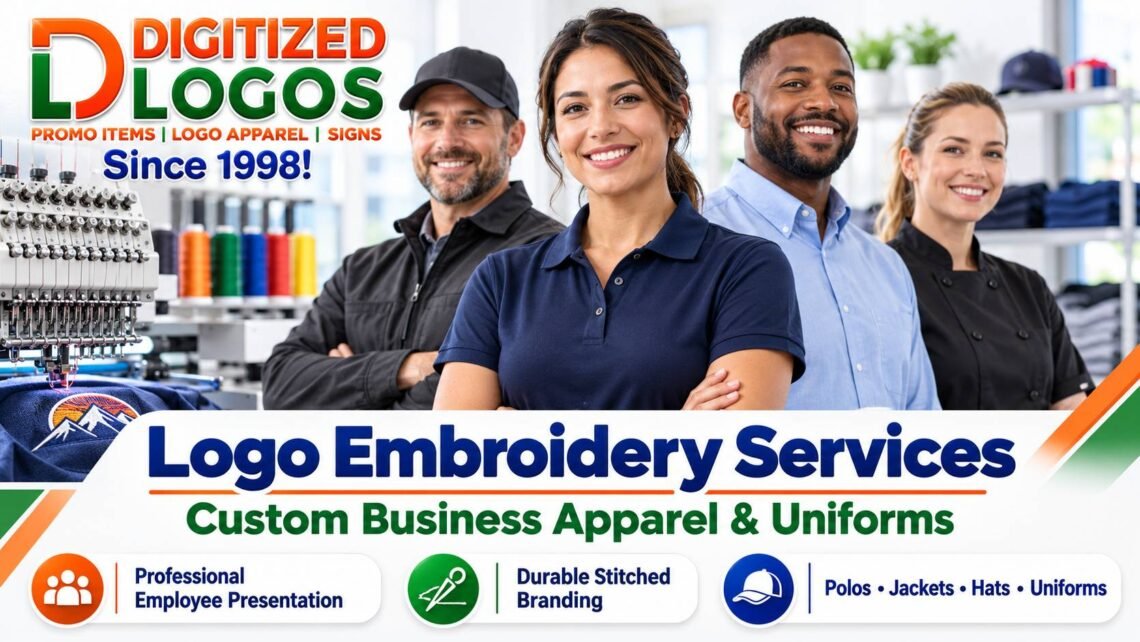
Professional apparel helps employees represent a business consistently, whether they work in an office, welcome hotel guests, visit customers, or manage projects in the field. With logo embroidery services, companies can add their branding to polos, jackets, dress shirts, hats, and other garments using stitched designs that create a textured, professional appearance.
For business buyers, choosing embroidery involves more than selecting a shirt and uploading a logo. Fabric compatibility, artwork preparation, thread colors, stitch density, logo placement, garment sizing, and reorder requirements all influence the finished product. Understanding these details helps purchasing teams select apparel that meets both branding and operational needs.
Digitized Logos provides branded apparel and promotional product solutions for organizations seeking customized employee clothing, corporate merchandise, and coordinated uniform programs. Its services include product sourcing, customization, and fulfillment support for business customers.
What Are Logo Embroidery Services?
Logo embroidery services use specialized equipment to stitch a company’s logo, name, or approved artwork directly onto fabric with embroidery thread. The process creates a durable, textured decoration that works especially well on many polos, dress shirts, jackets, hats, and uniforms.
Unlike methods that apply ink or a transfer to the garment surface, traditional embroidery forms the design with stitches. The result has a raised appearance that many businesses prefer for professional uniforms and corporate apparel.
Embroidery is particularly appropriate for designs with clear lettering, defined shapes, and a manageable number of colors. Small text, extremely fine lines, and photographic details may require artwork adjustments or a different decoration method.
Why Businesses Choose Custom Logo Embroidery
Embroidered apparel can serve several purposes within a company’s branding program. It can help customers identify employees, establish a consistent appearance across departments, and create branded clothing suitable for everyday work.
Professional Employee Presentation
Branded polos, embroidered button-down shirts, and coordinated outerwear help teams maintain a recognizable appearance. This is particularly useful for employees who interact directly with customers, attend meetings, or represent the organization at events.
Durable Branding for Regular Use
Properly produced embroidery can withstand repeated wear and appropriate laundering. Its durability depends on factors such as thread quality, garment construction, stitching, backing materials, and care practices.
For regularly worn uniforms, the garment itself also needs to be suitable for the work environment. Durable embroidery cannot compensate for fabric that is poorly matched to the job.
Consistent Corporate Identity
Businesses operating across departments or locations often need consistent logo sizes, thread colors, and placement. Standardized embroidery specifications make it easier to coordinate apparel and repeat approved designs on future orders.
Versatility Across Different Apparel Categories
A single embroidered logo program can support several garment styles, although each product may require adjustments to the design’s size, placement, or production settings.
For example, a company may choose embroidered polos for office staff, jackets for field teams, and caps for employees attending outdoor events while maintaining a recognizable brand identity.
Which Products Work Best With Logo Embroidery Services?
The most appropriate garment depends on the intended use, workplace conditions, desired appearance, and available embroidery area.
Custom Embroidered Polo Shirts
Polo shirts are a practical choice for businesses seeking apparel that balances comfort with a professional appearance. They are commonly used for customer service teams, sales representatives, hospitality employees, and corporate events.
Left-chest embroidery is a familiar placement because it keeps the logo visible without dominating the garment. Buyers should consider fabric weight, stretch, moisture management, fit, and logo contrast when selecting polos.
Embroidered Corporate Dress Shirts
Button-down dress shirts offer a more formal option for management teams, office employees, professional service providers, and client-facing staff.
Subtle embroidery can preserve the shirt’s professional appearance. Logo placement should account for pockets, seams, buttons, and the available decoration area.
Custom Embroidered Jackets and Outerwear
Fleece jackets, soft-shell jackets, quarter-zips, and other outerwear can accommodate embroidered branding when the fabric and garment construction are suitable.
For thicker materials, embroidery settings and backing selection may need adjustment to maintain design quality. Jackets with internal linings, waterproof membranes, or restricted decoration areas may require specialized handling.
Embroidered Hats and Caps
Caps are useful for outdoor teams, company events, promotional merchandise programs, and employee uniforms.
Headwear embroidery requires special attention to available space, cap structure, curvature, and seam placement. Designs that work on a flat polo shirt may need to be resized or simplified for the front of a cap.
Embroidered Workwear and Uniforms
Work shirts, service uniforms, and selected industrial apparel can also be customized with embroidery.
Garment selection should reflect the work environment. For safety-rated, flame-resistant, or other specialized protective clothing, buyers should verify whether embroidery materials and placement are compatible with the garment’s requirements and applicable manufacturer instructions.
How the Custom Logo Embroidery Process Works
Successful custom logo embroidery begins with artwork evaluation and garment selection. Preparing these elements before production can prevent avoidable revisions, inconsistent branding, and ordering delays.
- Select the apparel. Identify garments appropriate for employee responsibilities, comfort requirements, workplace conditions, and company branding.
- Submit the logo artwork. Provide a clear logo file, preferably an approved vector format when available, along with brand color information.
- Review embroidery feasibility. Evaluate whether lettering, borders, fine details, and design dimensions can be reproduced effectively with stitching.
- Prepare the embroidery file. Convert the artwork into machine-readable stitch instructions using embroidery digitizing software.
- Confirm thread colors and placement. Establish the appropriate color references, embroidery size, and position on each garment.
- Review the design proof. Check the proposed logo dimensions, position, and colors before approving production. A physical sample may be appropriate for complex or high-volume programs.
- Produce and inspect the apparel. Embroider the approved garments and check for visible defects, alignment, consistency, and overall appearance.
- Arrange delivery and future reorders. Coordinate shipping and retain approved branding specifications for subsequent purchases.
Some suppliers combine several of these steps, and the exact approval process varies by order. Buyers should confirm what is included before production begins.
What Is Embroidery Digitizing, and Why Does It Matter?
Embroidery digitizing is the process of translating artwork into stitch instructions that an embroidery machine can follow. It determines how the design will be sewn, including stitch direction, stitch type, sequence, density, and other production settings.
A high-resolution image or vector logo is not automatically an embroidery-ready file. Even visually simple artwork may need careful digitizing to reproduce correctly on fabric.
For example, a corporate logo containing narrow lettering and a detailed emblem may look sharp on a computer screen but become difficult to read when embroidered at a small size.
An embroidery specialist may recommend increasing the design dimensions, modifying the stitch approach, or simplifying details with the customer’s approval. These adjustments help preserve readability without unnecessarily changing the brand’s visual identity.
How Fabric Influences Embroidery Quality
Embroidery quality depends partly on the interaction between stitching and the garment material.
- Lightweight fabric: May require careful stabilization to limit puckering or distortion.
- Stretch fabric: Requires attention to fabric movement and stitch tension.
- Thick fleece: May benefit from a topping material that prevents stitches from sinking into the fabric surface.
- Structured caps: Require digitizing and production settings suitable for the cap’s shape and construction.
- Performance apparel: Should be evaluated for fabric properties, embroidery weight, and comfort.
Behind the scenes, backing materials, hooping technique, stitch density, needle selection, and machine tension can all influence embroidery results. Excessive stitch density, for instance, can create unnecessary stiffness or contribute to fabric distortion.
These production considerations explain why reviewing garment specifications and embroidery artwork together is more effective than treating them as separate purchasing decisions.
Embroidery vs. Screen Printing vs. Heat Transfer
Embroidery is not automatically the right decoration method for every product. The best choice depends on artwork complexity, garment material, order quantity, expected usage, and the appearance the business wants to achieve.
When Is Embroidery the Better Choice?
Embroidery is often well suited to corporate polos, jackets, caps, and uniform shirts where businesses want a textured, stitched logo. It is especially effective for clean artwork with recognizable shapes and readable lettering.
When Should a Business Consider Screen Printing?
Screen printing is commonly used for decorated T-shirts, event merchandise, and larger graphic applications. It can be economical for suitable production quantities, although pricing depends on the number of colors, print locations, and production setup.
When Is Heat Transfer Appropriate?
Heat transfer methods can accommodate detailed graphics, certain multicolor designs, and applications where embroidery may be too heavy or unsuitable for the fabric.
Transfer durability and appearance depend on the specific technology, garment compatibility, production process, and laundering practices.
How Does Dye Sublimation Compare?
Dye sublimation is particularly useful for compatible polyester apparel and full-color designs. It can support detailed graphics, gradients, and extensive garment decoration that would be impractical to reproduce using traditional embroidery.
For businesses planning both embroidered corporate uniforms and full-color promotional apparel, selecting the decoration method by product and intended use can create a more effective merchandise program.
How Much Do Logo Embroidery Services Cost?
The cost of logo embroidery services depends on the garment, design complexity, embroidery size, order quantity, number of decoration locations, and any required setup or preparation work.
There is no universal price for embroidered business apparel because different combinations of products and artwork can create substantially different production requirements.
Factors That Affect Embroidery Pricing
- Garment selection: Product brand, fabric, construction, and style affect the base price.
- Stitch count: Larger or more detailed designs may require additional machine time and thread.
- Digitizing requirements: New artwork may require embroidery file preparation or revisions.
- Order quantity: The number of garments can influence pricing and production efficiency.
- Decoration locations: Additional embroidery positions may increase production costs.
- Specialized materials: Unusual fabrics, backing requirements, or specialty threads may affect feasibility and cost.
- Shipping and deadlines: Delivery destinations and expedited requirements can change the final order cost.
When evaluating supplier quotations, businesses should request an itemized explanation of garment costs, decoration costs, setup charges, shipping, and any additional fees.
For ongoing uniform programs, the lowest initial unit price may not represent the lowest overall program cost. Reordering efficiency, garment durability, inventory handling, and replacement needs also deserve consideration.
Is There a Minimum Order Quantity for Custom Embroidery?
Minimum order quantities vary by supplier, garment, embroidery requirements, and purchasing program. Some products and services accommodate individual units, while others have minimum quantities based on production economics or product availability.
Digitized Logos offers flexible ordering options for selected branded products, including programs that accommodate single-item purchases. However, availability and minimum quantities for a specific embroidered product must be confirmed before ordering.
Businesses expecting regular purchases should also ask whether approved embroidery files and specifications can be used for future orders, and whether repeat setup charges apply.
Real-World Applications of Embroidered Business Apparel
Example 1: Hospitality Uniforms Across Multiple Properties
Consider a hypothetical hospitality company managing several properties. Each location needs embroidered polos for front-desk employees and coordinated outerwear for managers.
Without standardized ordering instructions, each property might purchase different shirt styles, choose slightly different logo dimensions, or position embroidery inconsistently.
A centralized apparel program could establish approved garment options, embroidery colors, logo placement, and reorder procedures. Property managers could then order within those established specifications, reducing unnecessary decisions and helping maintain consistent branding.
Example 2: Construction Company Employee Apparel
Imagine a construction company purchasing embroidered polos for supervisors, work shirts for field personnel, and jackets for employees working outdoors.
The purchasing team would need to consider durability, visibility, fit, and job-specific safety requirements in addition to logo appearance.
For ordinary corporate apparel, embroidery may provide a practical branding method. For protective workwear, however, garment certifications and decoration compatibility should be verified before customization.
Both examples are illustrative purchasing scenarios, not documented Digitized Logos customer projects.
How to Choose a Logo Embroidery Service Provider
Businesses comparing logo embroidery services should evaluate the supplier’s ability to manage product selection, artwork, approvals, and repeat orders, not simply the initial quoted price.
Before selecting a supplier, consider the following questions:
- Can the supplier recommend garments appropriate for the intended work environment?
- Does the supplier evaluate embroidery feasibility before production?
- Will buyers receive a design proof or sample approval opportunity?
- How are thread colors, design dimensions, and logo placement documented?
- Can the supplier coordinate different garment styles within one branding program?
- What are the confirmed minimum quantities and production schedules?
- Can the supplier support shipping to multiple business locations?
- How are defects, replacements, and future reorders handled?
A supplier that provides clear answers can help buyers understand their purchasing commitments and reduce the likelihood of avoidable production issues.
Common Mistakes to Avoid When Ordering Embroidered Apparel
Using Artwork That Is Too Detailed
Very small lettering, thin outlines, and complicated gradients can be difficult to reproduce with thread. Review the embroidery dimensions before approving artwork, especially for small chest logos and caps.
Ignoring Fabric Compatibility
A design that performs well on a heavyweight polo may need different embroidery settings on a lightweight performance shirt. Confirm that the artwork has been evaluated for the selected garment.
Choosing Thread Colors Without Reviewing Contrast
A logo may technically match the company’s brand palette but still be difficult to see against a similarly colored garment. Compare actual fabric and thread options wherever practical.
Skipping Size and Fit Planning
Employees need garments they can comfortably wear during regular work. Check available size ranges, product measurements, and fit options before submitting the final order.
Failing to Standardize Reorders
Businesses frequently reorder uniforms as employees join, departments expand, or clothing needs replacement.
Without retained specifications, later orders may use different logo dimensions, thread shades, or garment styles. Documenting the approved decoration details makes future purchasing more consistent.
Managing Embroidered Apparel for Growing Businesses
As organizations expand, managing branded clothing can become more complicated than purchasing one batch of shirts.
Purchasing teams may need to coordinate employee sizes, departmental budgets, approved apparel styles, multiple delivery addresses, and recurring replacement orders.
For these organizations, a structured uniform program or corporate apparel store can create a centralized purchasing process.
Depending on the program configuration, employees or authorized purchasers may be able to select from approved products rather than independently choosing garments and submitting new artwork for each order.
Digitized Logos offers company store, branded merchandise, and fulfillment solutions that can support coordinated apparel purchasing. Businesses should discuss their specific ordering permissions, available inventory arrangements, and delivery requirements before selecting a program.
Frequently Asked Questions About Custom Logo Embroidery
Can Any Company Logo Be Embroidered?
Many company logos can be adapted for embroidery, but not every detail will reproduce accurately at every size. Extremely small lettering, thin lines, and complex gradients may require modification. An artwork evaluation helps determine whether the original logo can be embroidered effectively or whether an alternative decoration technique would be more suitable.
How Long Does Custom Logo Embroidery Take?
Production time varies according to garment availability, artwork preparation, embroidery complexity, order quantity, and approval requirements. Shipping adds additional time. Buyers planning employee events, uniform launches, or scheduled distributions should confirm the production and delivery schedule with their supplier before placing an order.
Is Embroidery Better Than Printing for Company Uniforms?
Embroidery is often a strong choice for corporate polos, caps, jackets, and other uniforms requiring a professional stitched appearance. Printing may be more appropriate for large graphics, intricate designs, or certain lightweight fabrics. The better method depends on the garment, design, intended usage, and purchasing requirements.
Can Businesses Reorder Embroidered Apparel With the Same Logo?
Yes, provided the supplier retains or can access the approved embroidery specifications and suitable products remain available. Maintaining records of the embroidery file, thread colors, dimensions, placement, and garment choices can simplify reordering. Buyers should confirm whether repeat orders involve additional setup charges or updated product requirements.
How Should Embroidered Clothing Be Washed?
Follow the garment manufacturer’s care label. In many cases, turning embroidered clothing inside out, using an appropriate wash cycle, and avoiding excessive heat can help protect the garment and decoration. Care requirements may differ for performance fabrics, specialty threads, protective apparel, and garments with additional printed decoration.
Key Takeaways for Business Buyers
- Logo embroidery creates stitched branding suitable for many corporate polos, uniforms, jackets, and caps.
- Artwork digitizing, garment compatibility, stitch settings, and placement have a direct influence on the finished appearance.
- Pricing depends on garment selection, design requirements, quantity, and production specifications rather than one universal rate.
- Consistent embroidery specifications can make employee apparel programs and future reorders easier to manage.
- Businesses should evaluate supplier communication, proofs, product suitability, and fulfillment capabilities before purchasing.
Explore Professional Logo Embroidery Services With Digitized Logos
Choosing embroidered apparel should be a straightforward purchasing decision supported by clear product options, practical decoration guidance, and dependable ordering information.
Digitized Logos helps organizations source customized branded apparel, promotional merchandise, and corporate uniform solutions. Businesses can explore garment styles, discuss logo placement and decoration requirements, and evaluate purchasing options based on their needs.
Whether you are organizing a new employee uniform program, updating corporate apparel, or preparing branded clothing for an upcoming event, the right combination of product selection and embroidery planning can help maintain a consistent professional appearance.
Explore logo embroidery services and customizable merchandise through Digitized Logos.
Call: 301-963-3553
Email: info@DigitizedLogos.com
Share your logo, preferred garments, estimated quantities, and delivery requirements to discuss available customization options and request product-specific information.